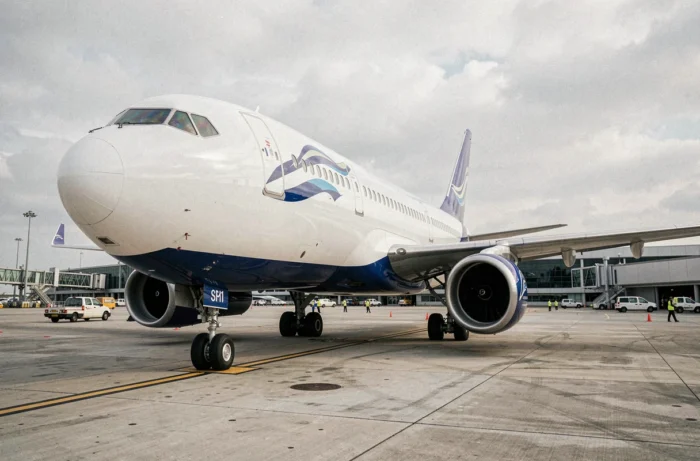
The aerospace sector is undergoing a phase of simultaneous tensions on multiple fronts: stricter carbon regulations, a shortage of maintenance technicians, and production rates under pressure at the two major manufacturers. European airlines have been absorbing since January 2026 the end of free carbon quotas under the EU ETS, while the obligations to incorporate sustainable fuels (SAF) imposed by ReFuelEU Aviation are starting to weigh on operating costs.
End of free carbon quotas: the real cost of the EU ETS for European airlines
Since January 1, 2026, airlines operating intra-European Economic Area flights no longer benefit from any free carbon quota allocations under the EU ETS. Each ton of CO2 emitted must be covered by purchasing quotas on the market.
The prices of these quotas hover around 80 to 90 euros per ton of CO2 in 2026, with projections sharply rising by 2030. The removal has occurred in stages: a 25% reduction in free quotas in 2024, a 50% reduction in 2025, and then a complete elimination this year.
To keep track of all these regulatory developments and their repercussions on air transport, specialized platforms like https://www.airnews.net/ aggregate aerospace news on a daily basis.
The case of AirBaltic illustrates the mechanics: the Baltic airline sees the carbon cost becoming a structural element of its operating accounts, far beyond what CORSIA credits represent for international flights. This imbalance between the EU ETS cost (intra-European flights) and the CORSIA cost (flights outside the EEA) creates a competitive distortion documented by several economic analyses.
The open question remains the price trajectory of the quotas. If the EU ETS market follows median scenarios, the carbon cost could exceed airport charges for some regional airlines by the end of the decade. Field reports diverge on this point: some carriers absorb the increase through their fares, while others compress their margins while waiting for stabilization.
ReFuelEU Aviation and sustainable fuels: an obligation that faces supply challenges
The other major regulatory constraint comes from ReFuelEU Aviation. The regulation requires jet fuel suppliers at European airports to incorporate an increasing percentage of SAF (Sustainable Aviation Fuel) in their deliveries.
On paper, Europe’s SAF supply has exceeded the mandate set for 2025. However, available data does not allow us to conclude that this lead will be maintained, for a simple reason: the European SAF sector largely depends on imports of used oils, particularly animal fats and recycled cooking oils, whose global supply is limited and contested with other sectors (road biofuels, green chemistry).
The additional cost of SAF compared to conventional jet fuel remains significant. Airlines are gradually passing this differential on through environmental surcharges, but transparency on these mechanisms varies from one carrier to another.
- The supply of used oils (UCO) constitutes the main bottleneck in SAF production in Europe.
- Synthetic SAF (e-fuels), produced from green hydrogen and captured CO2, remain at pre-industrial stages with costs several times higher than first-generation SAF.
- The ReFuelEU mandate provides for a gradual increase in quotas, which implies a need for production capacities that do not yet exist at the required scale.
Shortage of aerospace maintenance technicians: a hindrance to production rates
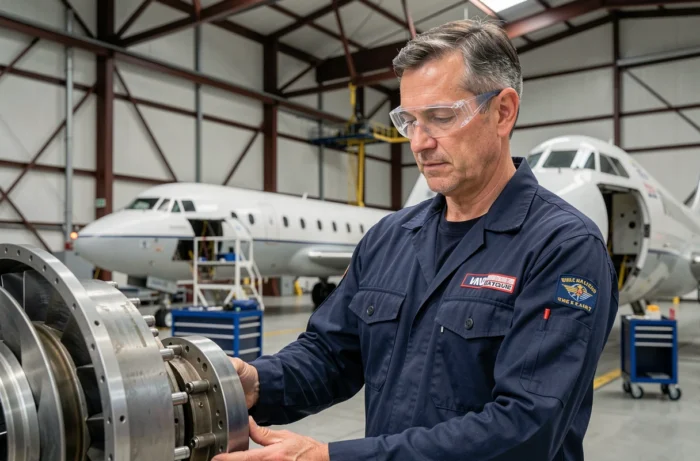
The growth of global air traffic faces a less publicized problem than the order books of Airbus or Boeing: the shortage of qualified personnel in aerospace maintenance. The demand for certified technicians is growing at a pace that training programs cannot keep up with.
This deficit affects all regions but particularly hits Europe and North America, where the aging workforce adds to the competition from other technical sectors that offer better pay. MRO (Maintenance, Repair and Overhaul) workshops are extending their turnaround times, which has a direct effect on fleet availability.
For airlines, the lack of technicians means aircraft are grounded for longer. For manufacturers, it slows the market’s ability to absorb new aircraft. Airbus is strengthening its delivery capacity for the A320 in Toulouse, but delivering an aircraft is pointless if the operator lacks personnel to keep it in service.
Airbus and Boeing: two industrial trajectories under pressure
On the manufacturer side, the dynamics diverge. Airbus continues to ramp up production of its A320neo family, with enhancements to its Toulouse facilities. Demand remains far greater than supply, and the order book extends over nearly a decade.
Boeing is navigating a more complex period. The timeline for the 777X continues to stretch, while Lufthansa has just exercised options on 20 Boeing 737-10s, a sign that the MAX program retains commercial viability despite the turbulence. Etihad is preparing to reactivate a final A380, confirming that the large aircraft remains relevant for certain high-density traffic hubs.
EVA Air is also considering an order for large aircraft to replace its last 777-300ERs, a renewal market where Airbus (A350) and Boeing (777X, if certified) are directly competing. The long-haul large aircraft segment concentrates the competitive stakes for both manufacturers over the next five years.
- Airbus is betting on a gradual ramp-up in production and diversification of its final assembly sites for the A320.
- Boeing must stabilize the certification of the 777X while managing the reputational and industrial consequences of recent incidents.
- The cargo market is experiencing its own movements: EgyptAir Cargo has completed its fleet of A330-200P2F, a sign of sustained demand for passenger-to-cargo conversions.
The European economic situation, regulatory cost increases, and geopolitical tensions weigh on air traffic demand in France. Aerospace remains a sector where long cycles structure decisions, but where short-term constraints – carbon, labor, supply chain – have never been so intertwined.