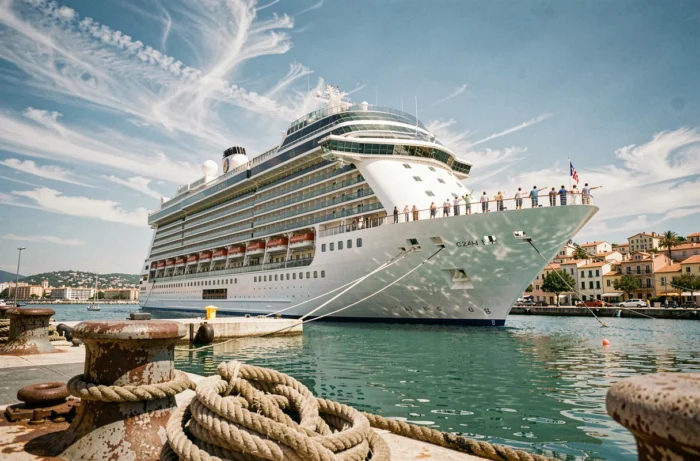
Cruise tourism in France is going through a paradoxical phase. While the global market continues to grow, the French territory is experiencing a slight decline in capacity, with companies redeploying their ships to regions deemed more profitable. This shift necessitates a rethink of the actual functioning of this sector and its prospects, far from the usual promotional rhetoric.
European Emissions Trading System: The Carbon Cost Redefining Itineraries
The gradual inclusion of maritime transport in the European Emissions Trading System (EU ETS) is profoundly changing the economics of cruises departing from France. For emissions in 2026, the accounted share reaches 100%. Since January 1, 2026, methane and nitrous oxide are also included in the scope.
Journeys between two ports in the European Union are covered at 100%, while routes connecting a European port to an external port are covered at 50%. This asymmetry directly impacts the calculation of rotations. A Marseille-Barcelona-Civitavecchia itinerary costs proportionally more in quotas than a crossing to Tunis or Tangier.
This constraint pushes some companies to favor stops outside the Union to reduce their regulatory exposure. This mechanism partly explains the redeployment of capacities away from French ports.
Shipowners who publish environmental commitments, such as the use of LNG or smoke treatment systems, do not fully offset the additional costs related to quotas. To better understand the foundations of this sector, find information on the La Petite Pierre website.
Capacity Limits on the Côte d’Azur: A Model of Port Regulation in France
Nice, Villefranche-sur-Mer, and Cannes have established or prepared limitations regarding the size of ships, the number of passengers disembarked, or the volume of annual stops. In Cannes, since January 1, 2026, the port is reserved for ships with fewer than 1,000 passengers.
This decision marks a turning point for the cruise sector in France. It means that megaships carrying several thousand passengers can no longer dock at certain historic ports on the Côte d’Azur. The economic model based on volume now faces a physical and political limit.
Consequences for Companies and French Ports
Companies must choose between accessible but less commercially attractive ports and premium destinations subject to strict quotas. For the ports involved, regulation aims to preserve the quality of life for residents and limit the saturation of tourist infrastructure on land.
This type of regulation does not yet exist in Marseille, France’s leading cruise port, but the issue is regularly raised there. The trend towards limiting stops is becoming widespread in the Mediterranean, with similar measures in Venice, Dubrovnik, or Santorini.
River Cruises in France: A Segment That Escapes Maritime Constraints
River cruising constitutes a distinct market, with its own navigation, pricing, and clientele logics. The basins of the Loire, Rhône, Seine, and Canal du Midi offer itineraries where nature and heritage replace saturated urban stops.
- Barges and small river boats generally accommodate a few dozen passengers, which reduces the impact on the sites traversed and allows stops in municipalities inaccessible to large ships.
- Environmental regulations differ: emissions from river boats do not fall under the same framework as maritime EU ETS, although motorization standards are gradually being applied.
- The price of a river cruise in France often remains comparable to a stay in a hotel of equivalent category, with meals and activities included in the offer.
River cruising attracts a family and nature clientele seeking a slow pace, in contrast to the model of large cruise ships. This segment is not experiencing the decline observed in maritime cruising and benefits from a strong territorial anchoring.
How a Cruise Works: What the Price Really Includes
The pricing structure of a cruise, whether maritime or river, remains opaque for many travelers. The displayed price generally covers the cabin, main meals, and access to the common areas of the ship. Shore excursions, drinks outside the package, cabin service, and premium activities (spa, specialty restaurants) are charged extra.
All-Inclusive Vacations or Variable Budget
Some companies positioned in the luxury or high-end segment include more services in the base price (drinks, excursions, tips). In the standard segment, additional expenses can represent a significant portion of the total budget. Comparing offers not just on the cabin price alone, but on the overall cost including predictable extras, remains the most reliable method.
The reservation process follows a model similar to that of airlines: prices vary according to the booking date, occupancy rate, and season. Booking early guarantees a better choice of cabin, but last-minute offers regularly appear for departures with low occupancy.
Prospects for Cruise Tourism in France After 2026
The decline in capacity observed in France does not reflect a disinterest among French cruisers for this form of vacation. It rather reflects the choices made by companies in response to a more restrictive regulatory environment and ports that voluntarily limit their traffic.
The rise of port regulations and carbon costs could favor medium-sized ships and river cruises, two segments where France has real advantages. The French river basin, with its canals, navigable rivers, and riverside heritage, offers a development ground that few European countries can match.
The future of cruising in France lies in smaller ships and itineraries with a lower footprint. Companies that anticipate this regulatory transition will retain privileged access to the most attractive French ports, while megaship operators will have to turn to other navigation basins.