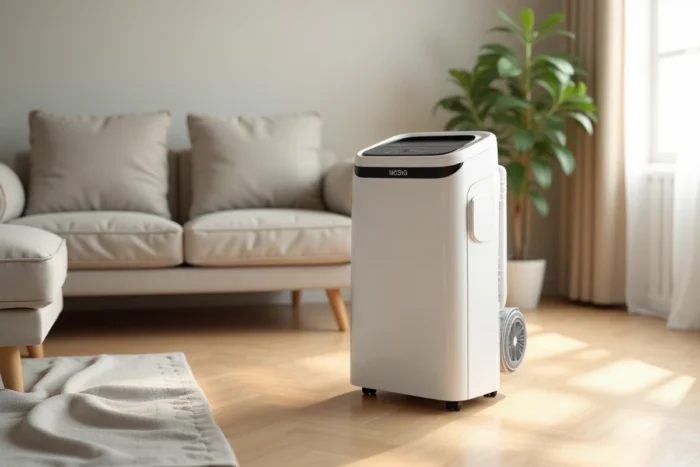
The Valberg portable air conditioner sold at Electro Dépôt catches the eye with its price, significantly lower than that of more established brand models. However, a low price says nothing about actual consumption, noise level during operation, or the ability to maintain a stable temperature in a south-facing room. It is these measurable parameters that determine whether the device lives up to its promises or turns the electricity bill into an unpleasant surprise.
Actual consumption of the Valberg portable air conditioner compared to a fixed model
Promotional articles highlight the cooling power, rarely the operating cost over a season. A monobloc portable air conditioner like the Valberg consumes significantly more than a wall-mounted split system with equivalent power. The reason lies in the design: the hot air expelled through the duct creates a depression in the room, which draws in warm outside air through the gaps in doors and windows.
This phenomenon forces the compressor to run longer to reach the set temperature. As a result, over a full summer of daily use, the consumption gap between a monobloc portable unit and a fixed system can represent a significant item on the bill.
| Criterion | Monobloc portable air conditioner (Valberg type) | Wall-mounted split air conditioner (entry-level) |
|---|---|---|
| Installation | None, ready to use | Installation by certified professional |
| Hot air evacuation | Duct to open window | Outdoor unit |
| Energy efficiency | Lower (depression in the room) | Higher (closed circuit) |
| Noise level | High (compressor in the room) | Low to moderate (compressor outside) |
| Condominium agreement | Not required | Often required |
| Purchase budget | Affordable | Higher (installation included) |
This table summarizes the real trade-off. The Valberg wins on ease of installation and purchase price. It loses on consumption, noise, and actual thermal comfort. A test of the Valberg portable air conditioner at Electro Dépôt confirms that the performance remains that of an entry-level monobloc, without any miracle related to the price.

Noise level of the Valberg: an underestimated parameter at purchase
The compressor of a portable air conditioner is located in the same room as the occupant. On an entry-level model, the noise during operation often exceeds the comfort threshold for sleeping. This point is rarely mentioned in commercial presentations, which focus on the BTU power.
Using the Valberg at night in a bedroom means tolerating a constant noise comparable to a low-volume conversation, or even more in full power mode. The “night” or “silent” mode, when available, reduces the airflow and thus the cooling capacity.
For a living room during the day (living room, office), the noise remains acceptable. For a bedroom, it is the main reason for dissatisfaction reported by users of portable air conditioners, regardless of the brand.
Set temperature and impact on electricity bill
Setting the air conditioning to a low temperature, around 22 °C, is a common reflex during a heatwave. Experts recently pointed out that a setting of 27 °C instead of 22 °C can halve consumption. On a portable unit that is already less efficient than a split system, this adjustment gap radically changes the cost of use.
Specifically, with a Valberg set to 27 °C in a properly shaded room, the compressor stops regularly and consumption remains contained. At 22 °C, it runs almost continuously, especially if the evacuation duct allows warm air to enter through the open window.
- Closing shutters or exterior blinds during sunny hours reduces the thermal load even before turning on the unit.
- Sealing the window opening around the evacuation duct as much as possible limits the depression and improves efficiency.
- Ventilating the room at night when the outside temperature drops, then closing everything in the morning, reduces the necessary operating time.
These simple actions do not turn a monobloc into a high-performance air conditioner, but they limit the overconsumption typical of this type of device.
Tenant or owner: the regulatory question often determines the choice
A portable air conditioner like the Valberg can be installed freely by a tenant, without the owner’s or condominium’s agreement. This is a decisive advantage for renters who cannot drill a wall or install an outdoor unit.
On the other hand, an owner considering a permanent installation should look into the split option, whose efficiency and acoustic comfort justify the higher installation cost over several summers of use.

Valberg portable air conditioner: for which type of housing
The Valberg is suitable for occasional use in a rental property, typically a studio or a one-bedroom apartment where installing an outdoor unit is impossible. It lowers the temperature by a few degrees in a small closed room, provided you can tolerate the noise and accept a higher electricity consumption than a fixed system.
For a property where the surface area or exposure multiplies heat gains (top floor, west-facing bay window, poorly insulated roof), the monobloc quickly reaches its limits. The compressor runs continuously without managing to stabilize the temperature, the bill rises, and the noise becomes difficult to endure over time.
- Studio or T2 in rental, used a few weeks a year: the Valberg serves its purpose as a backup solution.
- Attic apartment or poorly insulated house: passive measures (shading, night ventilation) should remain a priority before any air conditioner purchase.
- Owner-occupied housing with recurring heatwaves: a wall-mounted split, despite the higher initial cost, pays off in efficiency and comfort.
The purchase price of the Valberg at Electro Dépôt remains its main argument. But the total cost over a summer far exceeds the purchase price, considering electricity consumption, noise nuisances, and performance limits. Choosing with an understanding of these parameters avoids the disappointment that often follows the first nights of a heatwave.