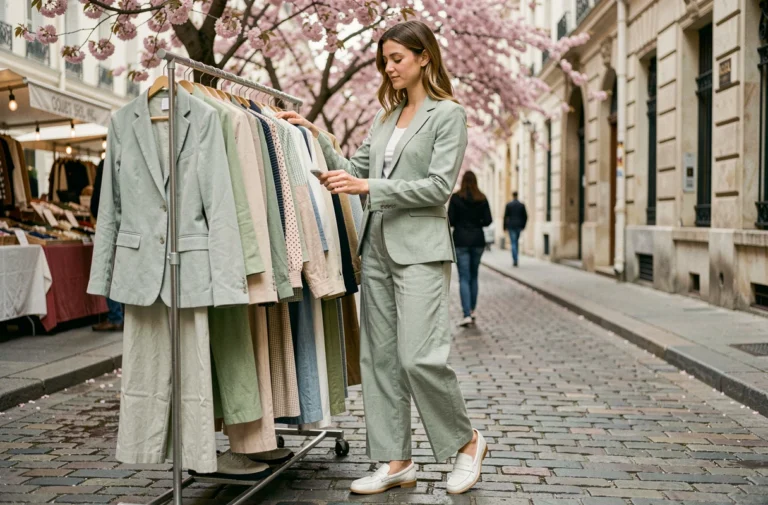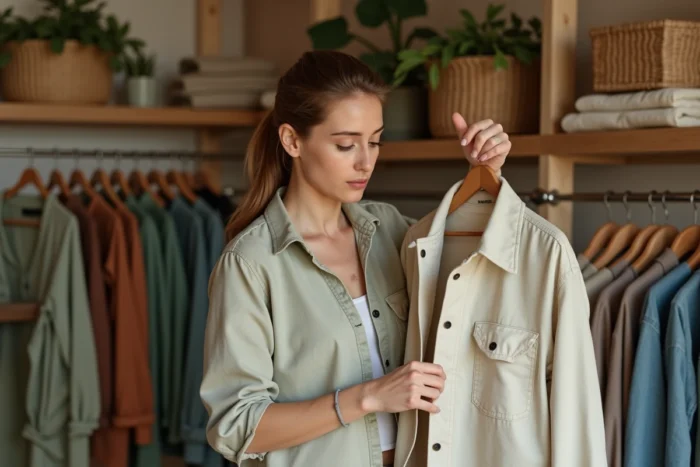
When you open your wardrobe and realize that half of the pieces haven’t been worn in a year, the question of sorting arises even before that of repurchasing. It’s often this practical trigger, much more than a theoretical discourse, that pushes towards sustainable fashion.
The motivations of eco-responsible consumers are varied, but they almost always stem from a concrete situation: a garment that tears after three washes, an illegible composition label, or a clothing budget that explodes for no clear reason.
Anti-fast fashion law in France: what changes for buyers
Since June 2026, France has adopted a law regulating ultra-fast fashion. The text prohibits any advertising for fast fashion across all media, including influencer marketing. Financial penalties for influencers promoting hauls or targeted brands can reach up to 100,000 euros.
The system goes further with a progressive penalty system via the REP scheme (Extended Producer Responsibility). These penalties could increase the price of fast fashion products by up to 10 euros per item by 2030, depending on their environmental impact. In practice, we are already paying more for a disposable t-shirt than we did two years ago, and the gap will widen.
This regulatory framework changes purchasing reflexes. When trying to understand why choose sustainable fashion, this law provides a direct economic response: responsible clothing becomes competitive against low-cost products whose real price is mechanically increasing.

Sustainable brands and labels: how to verify what you’re buying
On the ground, the main problem remains distinguishing a truly eco-responsible garment from a product painted green. Labels are multiplying, mentions of “eco” or “responsible” appear everywhere, and feedback varies on this point depending on the brands and distribution channels.
There are a few reliable benchmarks for sorting:
- The GOTS label (Global Organic Textile Standard) certifies organic cotton with social and environmental criteria verified by an independent organization.
- The OEKO-TEX certification guarantees the absence of harmful chemicals in the finished product, which directly concerns health when wearing.
Checking a label takes thirty seconds, but it prevents you from buying jeans presented as eco-friendly when they’ve traveled across four continents before arriving on the shelf.
Second-hand and upcycling: practices that really matter
There is a lot of talk about responsible consumption in terms of new brands, but the most effective action remains extending the lifespan of an existing garment. Second-hand and upcycling are not mere accessory trends: they are the two levers that most directly reduce pressure on resources.
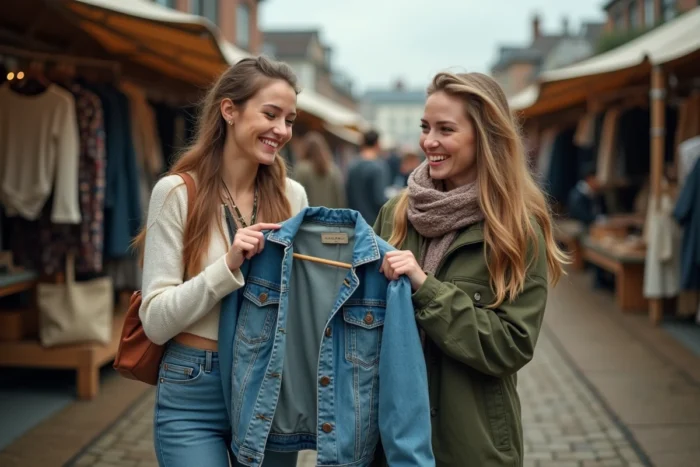
The second-hand textile market is growing strongly in France. Peer-to-peer resale platforms have professionalized, with authentication and quality control systems that did not exist five years ago. For consumers, buying second-hand divides the cost by two or three while removing a garment from the waste stream.
Upcycling, on the other hand, involves transforming a worn garment or fabric scraps into a new piece. Workshops offer to repair a torn pair of jeans to make a bag or to combine several shirts to create a unique piece. This practice meets a real demand from French consumers, who seek both originality and a reduction in textile waste.
Real cost of a sustainable garment versus fast fashion
The price argument remains the main barrier. An organic cotton t-shirt costs more to purchase than a synthetic equivalent produced en masse. On paper, fast fashion wins.
In practice, the calculation reverses when considering cost per wear. A durable garment withstands more washes, retains its shape and colors longer. A well-constructed pair of jeans worn for three years costs less per wear than a cheap pair replaced every six months.
The anti-fast fashion law accelerates this shift. With REP penalties gradually increasing the price of disposable products, the price gap between sustainable fashion and fast fashion is narrowing each year. Consumers who integrate this parameter into their budget find that responsible fashion is not a luxury, but a rational trade-off.
Motivations of eco-responsible advocates: beyond the environment
Reducing carbon footprint and limiting plastic pollution in the oceans are well-known motivations. Synthetic microfibers released during washing contaminate aquatic environments.
What attracts less attention are the social and personal motivations:
- Working conditions in textile production workshops remain a sensitive topic, and choosing certified brands means demanding decent wages and conditions.
- Wearing fewer, better-chosen garments simplifies daily life. Several advocates of the capsule wardrobe report a gain in time and a reduction in stress related to clothing choices.
- The durability of a garment creates attachment: we repair what we love to wear, we resell what we no longer wear, and the relationship to products changes when each piece has been chosen with intention.
Sustainable fashion is not a renunciation of style. It is a decision filter that combines budget, environmental impact, and production ethics. Practices are evolving rapidly, driven by a stricter legal framework and consumers who now understand what a garment truly costs, from the cotton field to the back of the wardrobe.