
The price of a house extension in France is not limited to a square meter range. Since 2021, construction price indices have risen by nearly 20% according to Insee, an increase that affects both raw materials and labor. Understanding the actual cost of an extension requires examining what, in each project, shifts the budget from one level to another.
Construction Cost Inflation: What 2024 Quotes No Longer Reflect
Items that display prices per square meter often date back to estimates made before the inflation wave. The maintenance-improvement cost index (IPEA) and the construction production price index (ICP-F), published by Insee, show a continuous upward trajectory since 2021.
This dynamic affects several items simultaneously. The price of framing wood, concrete blocks, and the rates of skilled craftsmen: each line of the quote absorbs a portion of this inflation. An estimate made two years ago for a project similar to yours likely underestimates the actual budget by several thousand euros.
For those looking to accurately assess the cost of a house extension, it is essential to request quotes dated less than three months ago and ask companies if their rates include a price revision clause related to materials.
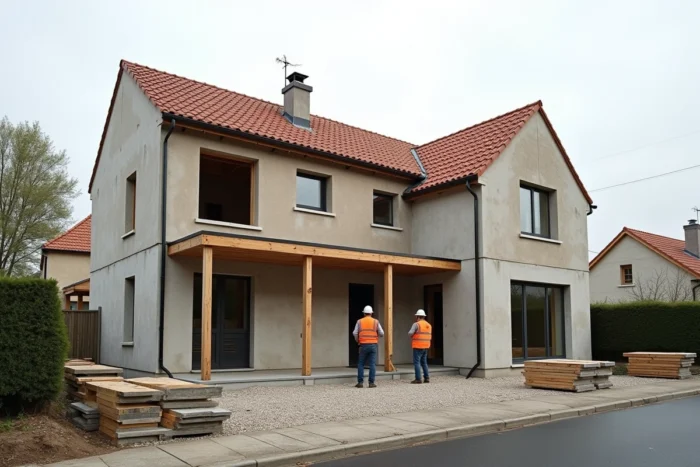
Extension Materials: Price Differences Between Wood, Concrete Block, and Mixed Structure
The choice of material structures the entire budget. Three families dominate the residential extension market, and their financial implications go beyond the simple purchase price.
Wood Frame
The wooden extension appeals due to its quick implementation. The construction time is shorter, which reduces on-site labor costs. However, the price of wood remains sensitive to supply tensions. The final cost of a wood frame often exceeds that of concrete blocks, especially when exterior finishes (cladding, treatment) are taken into account.
Concrete Block and Traditional Construction
Concrete block remains the cheapest material to purchase for the structural work. Its implementation requires more time, which partially offsets the savings on the raw material. Thermal insulation, whether external or internal, is systematically added to the budget, where wood offers better native thermal performance.
Mixed Structure
Some projects combine a concrete block base (foundation, load-bearing walls) with a wooden envelope. This approach allows for optimizing the strength-insulation ratio but complicates coordination between trades and extends timelines.
- Wood reduces the duration of the construction but exposes the budget to fluctuations in the construction wood market.
- Concrete block offers the lowest purchase cost, offset by a longer installation time and a need for additional insulation.
- Mixed construction adds required skills and interfaces between lots, which can generate unexpected additional costs.
Hidden Items That Derail the Budget of an Extension
The price ranges per square meter published online generally cover the structural work and finishing work. Several items are absent from these estimates and yet represent a significant portion of the total cost.
The soil study is often an underestimated item. On clay or sloping land, this study determines the type of foundations and can radically alter the structural budget. Architect fees, mandatory for areas exceeding 150 m² of total floor space after work, represent about 10 to 12% of the project costs according to analyzed competitor data.
Administrative fees also deserve to be anticipated:
- Preliminary work declaration or building permit depending on the created area, with processing times varying from one municipality to another.
- Connections to existing networks (water, electricity, sanitation), the cost of which depends on the distance between the extension and the connection points.
- Compliance of the existing structure, sometimes required by the PLU when submitting a permit (for example, sanitation standards compliance).
- Development tax, calculated on the taxable area created, the amount of which varies by municipality.
These additional items can represent 15 to 25% of the overall budget, a gap that many homeowners discover during construction.

Financing an Extension: The PTZ Expanded to Individual Houses
The reform of the Zero Interest Loan that took place in April 2025 changed the financing conditions for construction projects. The PTZ is now open to new individual houses across the entire territory, both in tight and relaxed zones (A, Abis, B1, B2, C).
Income ceilings and financing amounts have been increased by 8 to 13% in 2026 depending on the geographical area. This evolution may concern certain extension projects, especially when the extension is part of a new construction or eligible heavy renovation operation.
Field feedback varies on this point: the eligibility of an extension for the PTZ depends on the exact nature of the project and its administrative processing (new building permit or modification of the existing structure). Consulting a broker or the lending bank remains necessary before incorporating this device into the financing plan.
Moreover, MaPrimeRénov’ can cover part of the insulation work carried out during an extension, provided that the energy aspect of the project meets the criteria in force in 2026. Combining extension and energy renovation allows for cost-sharing on the same site.
The cost of a house extension remains difficult to standardize. Each project combines local variables (soil type, urban planning rules, site access) and technical choices that can vary the bill from simple to double. The only reliable constant: a budget forecast that does not include additional items and the recent inflation of materials will be exceeded.