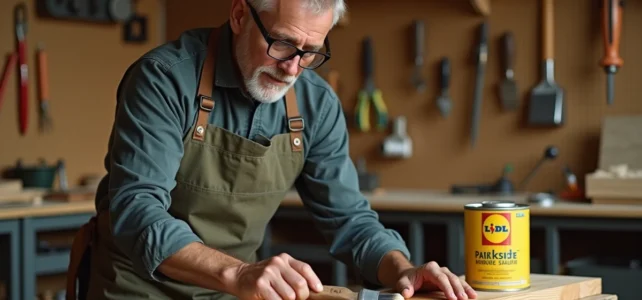
The Parkside polyurethane stain is a wood finishing product sold by Lidl under its home tool brand. Manufactured by Baufix, it comes in a 5-liter can, usually in rosewood shade, and promises protection for wood both indoors and outdoors. User feedback on this product ranges from satisfaction for occasional use to concerns about its long-term durability.
Parkside Lidl Stain: What the polyurethane base actually changes
The term “polyurethane” in the commercial name of this stain is not incidental. A polyurethane resin gives the stain film a hardness superior to that of a standard acrylic stain. The treated wood is better resistant to friction, light impacts, and surface abrasion.
This characteristic explains why some DIY enthusiasts choose Parkside for elements subjected to regular contact: shutters, garden gates, railings. The polyurethane resin forms a more rigid barrier against moisture than water-based acrylic binders, which slows down water penetration into the fibers.
On the downside, a polyurethane film is less flexible than an acrylic stain. On wood that undergoes significant movement (south-facing cladding, young softwood), the film may micro-crack after a few seasons rather than following the movements of the substrate. Each user review of the Parkside Lidl stain mentions the quality of the initial appearance, but durability varies depending on the wood species treated and exposure.
User reviews of Parkside: immediate satisfaction, questions about durability
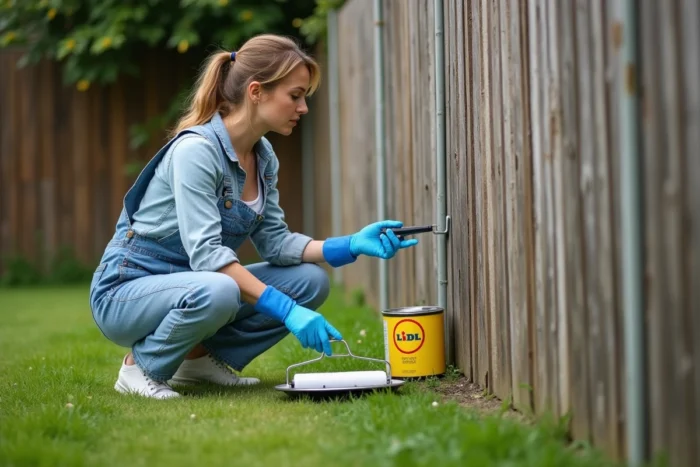
Reviews published by DIY enthusiasts converge on one point: the application is simple and the aesthetic result is pleasing from the first coat. The stain spreads easily with a wide brush or roller without any particular difficulty, with a decent covering power for a semi-transparent stain.
The drying time between coats remains reasonable, and the smell during application is considered tolerable by most users. The rosewood shade gives a warm and uniform appearance that highlights the wood grain.
Limitations noted after a few months
Concerns arise in medium-term feedback. Several users report premature graying on horizontal surfaces exposed to direct rain (top of railings, coping stones). On vertical surfaces protected by an overhang, the durability seems significantly better.
The frequency of renewal strongly depends on orientation and exposure. A shutter sheltered under an awning retains its color much longer than a garden fence in full sun. This observation is not unique to the Parkside brand, but it weighs more heavily on an entry-level product whose protective film is less loaded with UV-filtering pigments than a premium stain.
Parkside’s public positioning: interpreting reviews in context
One element rarely mentioned in online discussions deserves to be stated clearly. The Parkside brand is explicitly positioned by Lidl for occasional domestic use, not for intensive professional use. This positioning applies to the entire range (power tools, garden accessories, finishing products).
Parkside equipment specialists recommend reserving the brand for home or garden DIY contexts, based on reliability feedback collected over several years. The Parkside polyurethane stain fits this logic: it serves its purpose for protecting a pergola, a garden shed, or wooden garden furniture, without claiming to compete with professional stains formulated for demanding projects.
Enthusiastic reviews generally come from DIY enthusiasts using it in this specific context. Negative reviews often come from users who expected durability comparable to specialized brands sold at two to three times the price per liter.
Application conditions: errors that skew reviews
Some negative feedback can be explained by classic preparation errors. The polyurethane stain adheres poorly to oily, damp wood or wood already covered with an un-sanded old treatment. Here are the points of caution that come up in the testimonials of satisfied DIYers:
- Sand the wood with fine grain and dust thoroughly before the first coat, even on raw wood that seems clean
- Apply at least two coats while respecting the indicated drying time, paying extra attention to end grains (ends of boards) that absorb more
- Avoid application in humid weather or below a certain temperature, as incomplete drying compromises the durability of the film
- Do not overload the brush: several thin coats protect better than a thick coat that may run or peel
A often overlooked point: preparing new wood
For new wood treated in autoclave (the greenish wood sold at DIY stores), it is necessary to wait until the wood dries sufficiently before applying the stain. Some negative reviews regarding the durability of Parkside concern applications on wood still impregnated with residual moisture, which prevents the resin from properly penetrating the fibers.
Parkside stain compared to alternatives: real value for money
The price per liter of Parkside stain places it significantly below references like V33, Bondex, or Xyladecor. For a DIYer treating a modest area (a garden shed, a few shutters), the budget difference remains limited in absolute terms. On a large terrace, the cost difference becomes more significant.
The real calculation concerns the frequency of renewal. If Parkside stain requires a new coat every year on a highly exposed surface, while a specialized brand stain lasts two seasons, the initial savings disappear. On sheltered or vertical surfaces, the financial gain remains tangible since the durability approaches that of more expensive products.
The Parkside polyurethane stain from Lidl fulfills its function for a DIYer willing to regularly renew the treatment on the most exposed areas. Its limitations are not a manufacturing defect but the logical consequence of an entry-level positioning. The choice boils down to a question of the surface to be treated, exposure, and tolerance for periodic maintenance.