
A refrigerator produces cold inside by expelling heat to the outside. This thermal transfer occurs through a closed circuit containing a refrigerant that absorbs heat in the compartment and then releases it into the ambient air via a component called a condenser. The warm walls of the fridge are therefore a direct consequence of this mechanism, not a malfunction in itself.
Condenser integrated into the walls: the design that changes everything
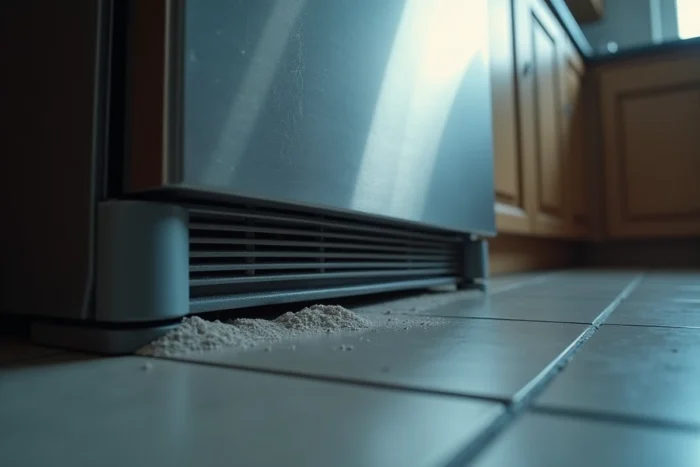
Older refrigerator models dissipated heat through a visible black grille at the back of the appliance. On most recent devices, manufacturers have abandoned this grille in favor of condensers directly integrated into the side panels.
This evolution responds to constraints of embedding and design. A fridge without a protruding rear grille can be more easily placed against a wall or in a kitchen nook. The trade-off: heat diffuses through the side walls and sometimes around the door seals, which surprises users accustomed to older models.
To understand why the walls of the fridge are warm, it is essential to keep in mind that this heat transfer through the sides is the norm in current appliances, not a sign of failure.
Normal temperature of fridge walls: reliable benchmarks
Touching a warm wall does not mean the appliance is malfunctioning. The Chinese standard GB 4706.13-2014, which serves as an international reference for large household appliances, considers a normal operating range for side walls between approximately 42 and 48 °C when the ambient temperature reaches 35 °C, provided that the interior remains compliant (between 0 and 4 °C for refrigeration, -18 °C for freezing).
A simple test can assess the situation: place your hand flat on the side wall. If you can maintain contact for several seconds without pain, the temperature remains within an acceptable range. If the contact becomes difficult to bear, the appliance is likely exceeding the normal range.
The role of the compressor in perceived heat
The compressor, located at the bottom rear of the fridge, compresses the refrigerant and generates heat during this process. On recent models equipped with an Inverter compressor, the motor runs continuously at a moderate speed rather than in abrupt stop-and-start cycles. The heat produced is therefore constant but less intense than on older models.
A warm compressor, even quite hot to the touch, operates normally as long as the interior temperature of the fridge remains stable.
Causes of abnormally warm walls on a refrigerator
When the walls exceed the usual heat to the point of becoming scorching, several causes deserve to be checked. Repair technicians follow a specific diagnostic order.
Clogged condenser: the first thing technicians check
The condition and cleanliness of the condenser is the first check performed by professionals during an intervention. On models with a rear grille, a simple layer of dust acts as a thermal insulator. The condenser no longer dissipates heat properly, forcing the compressor to run more and raising the temperature of the walls.
On models with a condenser integrated into the sides, the problem manifests differently: it is the accumulation of dust on the lower grille or on the condenser fan (when it exists) that causes the same insulating effect.
Lack of ventilation around the appliance
A refrigerator pressed directly against a wall or wedged between two pieces of furniture without air circulation space cannot properly expel its heat. Warm air stagnates around the appliance, and the walls heat up.
- Leave a few centimeters of space between the sides of the fridge and adjacent surfaces, including the back wall
- Check that nothing is placed on top of the appliance that would block the natural convection of air
- Keep the refrigerator away from any direct heat sources: oven, radiator, sun-exposed window
Frosted evaporator or failing circuit
When the evaporator (the internal part that captures the cold) becomes covered with excessive frost, the heat exchange deteriorates. The compressor compensates by running longer, which increases the heat dissipated by the walls. This frost can result from a worn door seal, a frequently opened door, or an automatic defrosting issue.
A refrigerant leak produces a similar effect: the circuit loses efficiency, the compressor runs continuously without managing to cool the interior, and the walls heat up abnormally. This type of failure requires the intervention of a qualified technician.
Concrete solutions to reduce the heat of fridge walls
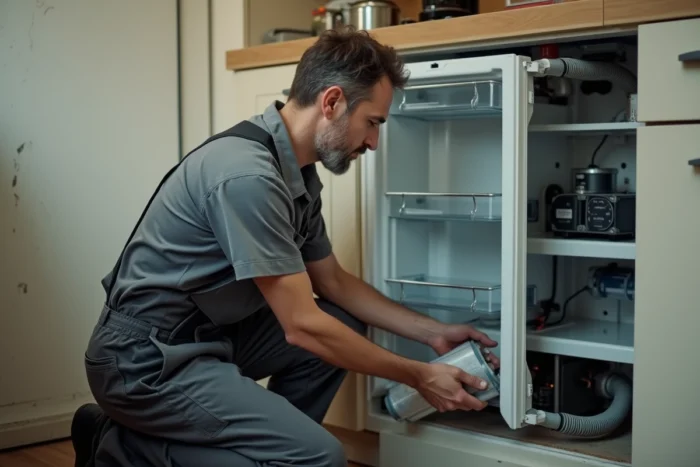
Before calling a repair technician, several checks can help resolve the issue or at least diagnose it.
- Clean the condenser (rear grille or lower grille depending on the model) with a vacuum cleaner with a fine nozzle or a soft brush at least twice a year
- Check the seal of the door by sliding a sheet of paper: if it falls without resistance when the door is closed, the seal is no longer sealing properly
- Set the interior temperature around 4 °C for the refrigerator and -18 °C for the freezer, no more, no less
- Avoid overloading the appliance: a fridge filled beyond its reasonable capacity hinders internal air circulation and forces the compressor to work harder
- Let hot dishes cool before placing them in the refrigerator to avoid imposing a heat spike on the circuit
If despite these actions the walls remain scorching and the interior temperature does not drop, the problem likely lies with the compressor, the thermostat, or a refrigerant leak. In this case, calling a technician prevents further damage.
A fridge with warm walls after a hot summer day is still a functioning appliance. The walls only become a warning signal when the external heat is accompanied by a rise in temperature inside the compartment, noticeable by food that no longer stays fresh or frost melting in the freezer compartment.