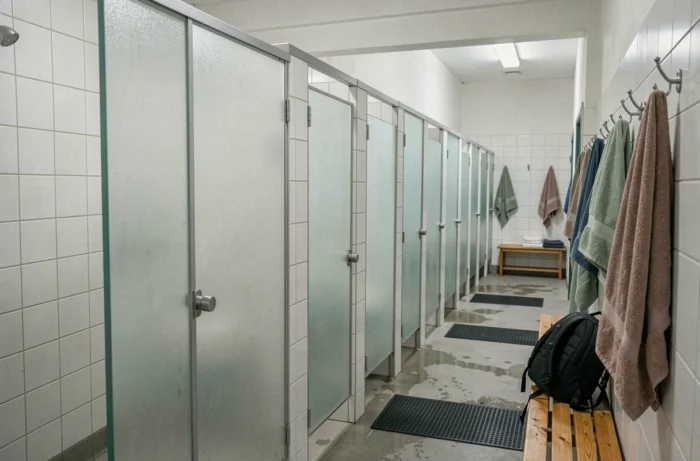
The quality of a shared shower in a youth hostel rarely hinges on water flow or temperature. It primarily depends on technical parameters that most travelers only check afterward: ventilation, flooring, documented cleaning frequency, and physical separation of stalls. We observe that the gap between comfort and discomfort lies in specific design choices, not merely in the opposition of “private shower versus shared shower.”
Ventilation and flooring: the invisible criteria of a shared shower
A shared shower without proper mechanical extraction accumulates residual humidity in less than an hour. The result: mold in the joints, a constantly slippery floor, and a musty smell. We recommend checking for the presence of a mechanical ventilation system or an active extractor before even looking at the apparent cleanliness of the stalls.
The flooring is another reliable indicator. A tile with a high slip resistance coefficient (textured surface, narrow joints) significantly reduces the risk of falls and limits water stagnation. Establishments that opt for a smooth and shiny floor, easier to photograph, create exactly the conditions that travelers describe as “unclean wet floors” in their negative reviews.
Recent feedback on capsule hostels in Asia and Europe confirms this correlation: when the floor dries quickly between uses, the perception of cleanliness increases significantly, even without intermediate cleaning. The architecture of the shower does more than just the passing of a mop.

Cleaning frequency and visible protocol: what separates comfort from discomfort
The topic that recurs in the majority of negative reviews about shared showers in youth hostels is not the absence of partitions or the lack of hot water. It’s the smell. Reports of persistent urine odors, questionable towels left on the floor, and grimy shower trays consistently appear in establishments where cleaning is not daily or not visible.
In contrast, hostels that display a timestamped cleaning schedule in every bathroom receive radically different comments. Their shared showers are described as “always immaculate” and “without waiting,” because the visible regularity of cleaning reassures as much as it cleans.
We observe that some recent establishments, particularly capsule hostels in Tokyo, London, or Almaty, have adopted a protocol inspired by sports clubs: wall-mounted soap dispensers refilled daily, towels provided and collected after each use, and sometimes even amenities like heated bidets. This model transforms the shared shower into a service perceived as premium.
Signals to check before booking
- The explicit mention of daily cleaning of the restrooms in the establishment description, not just “shared restrooms”
- The presence of photos of the showers on the booking page (an establishment that never shows its showers usually has a reason)
- Recent reviews specifically mentioning the cleanliness of the bathrooms, not just the overall rating of the hostel
- The indication of provided soap or shower gel dispensers, a sign of centralized maintenance rather than left to travelers
Design of the stalls: full partition, curtain, or open space
The physical separation between shower stations directly determines the level of perceived privacy. Three configurations coexist in the current landscape of youth hostels.
Stalls with full partitions and lockable doors replicate the conditions of a private bathroom. They generally include a dry area for changing, separated from the wet zone by a step or ledge. This is the standard for recent or renovated establishments.
Curtain stalls offer visual separation but not acoustic, and the wet curtain that clings to the skin remains one of the most frequent complaints. The absence of a dry area forces guests to place their belongings in the wet zone or leave them outside.
Open spaces like changing rooms, with several showerheads aligned without separation, still exist in some older hostels or in large-capacity structures. This format tends to disappear in favor of individual stalls, even in the most budget-friendly establishments.
The impact on waiting time
Paradoxically, closed stalls with a dry area extend the duration of occupancy per traveler. A curtain shower station frees up faster because no one lingers there. The ratio of the number of stalls to beds remains the true indicator of fluidity. An establishment with four closed stalls for forty beds will create more queues than one with eight curtain stations for the same number of beds.

Shared showers in hostels: amenities that truly change the experience
Beyond cleanliness and privacy, a few concrete amenities tilt the experience towards comfort.
- A hook or shelf in the dry area of the stall allows keeping towels and clothes dry, eliminating the main source of frustration in shared showers
- An individual mirror in each stall or in the immediate vicinity prevents congestion in front of a single mirror above the sinks
- Sufficient lighting (not a harsh neon overhead) enhances the feeling of safety and cleanliness, two perceptions closely linked
- Shower sandals available at the reception or in a dispenser, a solution adopted by several hostels in Southeast Asia to address foot hygiene concerns
The question of comfort in shared showers is not limited to a binary choice between “it’s okay” and “it’s uncomfortable.” It breaks down into measurable parameters: ventilation, flooring, stall/bed ratio, cleaning protocol, dry area equipment. An establishment that ticks these boxes transforms a budget constraint into a functional service. Travelers who consult reviews filtering for mentions of bathrooms save time compared to those who discover the reality upon arrival.