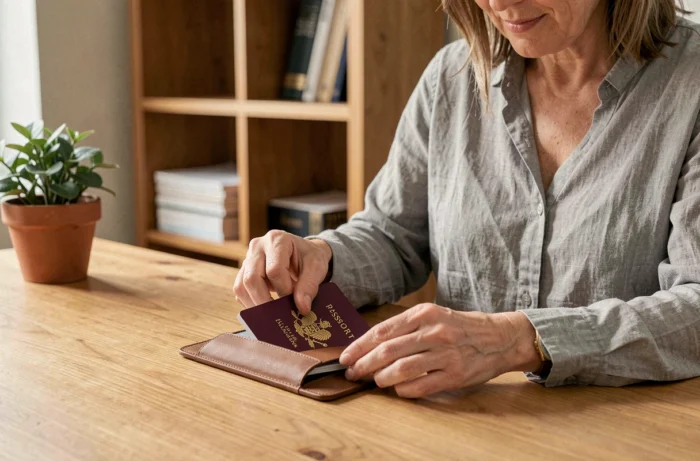
A passport slipped into a kitchen drawer, wedged between two bills and an old checkbook: this is how many households treat their travel document. The problem arises on departure day when you turn the house upside down without finding it, or worse, when you retrieve it warped by humidity. Properly storing and protecting your passport at home requires little effort but a minimum of method.
Damaged or lost passport at home: what it really costs
A passport with a peeling cover or a crumpled photo page can be refused at border control. The document remains technically valid, but an agent is entitled to deem it non-compliant if the security features are altered.
Renewing a passport takes several weeks, sometimes longer depending on the period. Not to mention the fees for the new application and, in some cases, the outright cancellation of the trip. Properly storing this document at home spares you disproportionate stress compared to the effort of organizing it.
The domestic enemies of the passport are concrete: humidity, direct light, and heat. A bathroom, a windowsill, or an uninsulated attic is enough to degrade the paper and ink in a few months. Choosing a suitable passport holder or passport protector limits these risks on a daily basis.
Passport storage: choose a fixed and consistent location
Have you ever noticed that the items we lose the most are those without a designated place? The passport follows the same logic. The first rule is to assign it a unique location in the home, known to all household members.
Separate current documents and lifetime documents
Recent guides on managing family papers classify the passport in the same category as civil status documents and diplomas. These are documents referred to as “lifetime” that deserve separate storage from current bills or mail to be processed.
Practically, this means a drawer, a box, or a binder reserved solely for identity documents and official papers. A piece of furniture in a dry and temperate room (bedroom, office) is better than an entryway exposed to drafts or a damp basement.
Criteria for a good storage location
- A room where the temperature remains stable, without excess heat or humidity (avoid kitchen, bathroom, garage)
- A closed container that protects from dust and light: opaque sleeve, metal box, locked drawer
- A place that is quickly accessible before departure, but not obvious to a visitor or burglar
- If possible, a fire-resistant storage (fireproof box) for households that keep multiple official documents in the same place
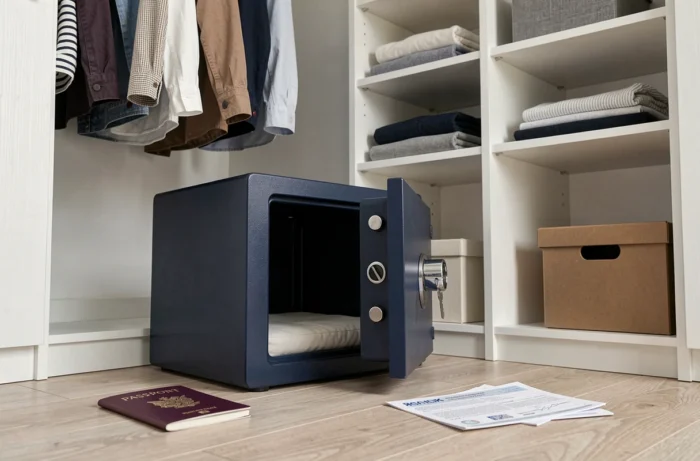
The home safe remains the safest solution. Even a compact model mounted on a wall in a closet offers protection against theft, fire, and humidity that no standard drawer can match.
Physical protection of the passport against domestic wear
Even stored in the right place, a passport without protection wears out. The pages rub against other documents, the cover gets scratched, and the corners become dog-eared over time.
Dedicated sleeve or hard case
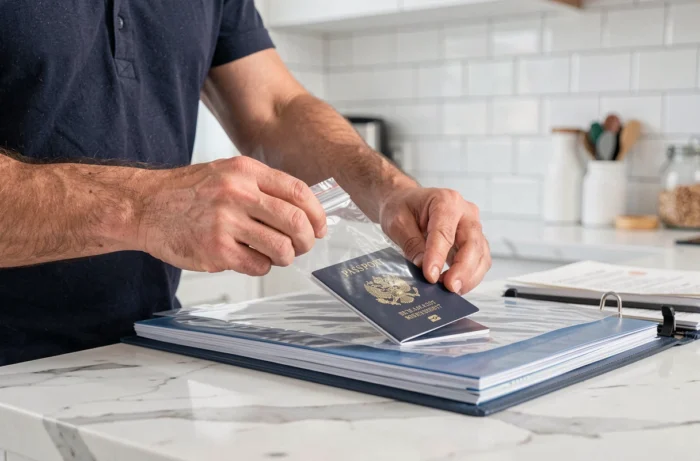
A soft plastic zip sleeve is sufficient to isolate the passport from ambient humidity. For more durable protection, a semi-rigid case made of leather or synthetic material absorbs shocks and friction.
A case with RFID blocking also protects the electronic chip from unauthorized readings. Most recent passports include a contactless chip. Even at home, an RFID case prevents any concerns about the security of the data stored in the document.
Protecting the photo page and visa pages
The identity page is the most consulted and the most fragile. A transparent adhesive protective film, sold at stationery stores, extends its lifespan without hindering optical reading. Just make sure the film does not cover the automatic reading area (the character strip at the bottom of the page).
For frequent travelers, the visa pages deserve as much attention as the cover. A smudged stamp or a page stuck to another can complicate a future check. Sliding a thin separator between used pages limits this risk.
Children’s passports in case of parental separation
In separated families, the question of storing the child’s passport goes beyond simple domestic organization. Who keeps the original? In which household?
Family law practitioners now recommend explicitly designating a usual storage location for the originals and formalizing it between the two parents. The passport remains physically with one of them, but the other knows exactly where it is and how to obtain it before a trip.
In parallel, each household can keep a digital or paper copy of the child’s passport. This precaution avoids last-minute conflicts and speeds up procedures in case of loss.
Copies and digital backups of the passport
Storing the original does not exempt you from planning a backup solution. A copy of the passport, stored separately, greatly simplifies procedures in case of theft or accidental destruction.
- Scan the identity double page in high resolution and store the file in a secure cloud service (with two-factor authentication)
- Keep a paper photocopy in a second physical location: with a trusted relative, in a bank safe, or in another piece of furniture in the home
- Save a readable photo of the passport on your phone, in a password-protected folder
The copy never replaces the original, but it speeds up renewal and serves as a temporary proof at a consulate abroad.
Also remember to regularly check the expiration date on your stored passport. Some countries require several months of residual validity after the expected return date. Discovering this detail the day before departure is exactly the type of unpleasant surprise that organized storage helps to anticipate.