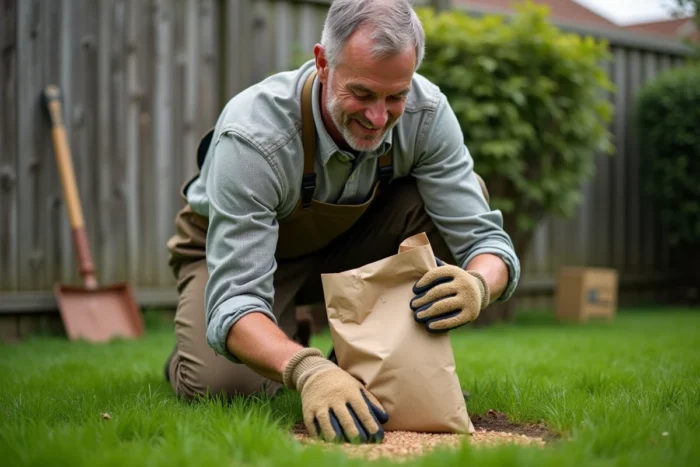
A fertilized lawn with synthetic fertilizer greens up in a few days, then stagnates. The same lawn nourished with an organic source takes longer to respond, but its root density and resistance to trampling improve over several months. This difference in kinetics reflects a fundamental mechanism: microbial mineralization, the only process that truly synchronizes the release of nutrients with the soil’s absorption capacity.
C/N Ratio and Mineralization Rate: The Parameter Ignored by Labels
The performance of an organic lawn fertilizer primarily depends on its carbon/nitrogen ratio. An amendment with a C/N ratio exceeding 25 mobilizes nitrogen from the soil to decompose, causing a temporary nitrogen deficiency and paradoxical yellowing of the lawn.
Formulations based on feather meal or ground horn show a low C/N ratio, often around 3 to 5. The organic nitrogen they contain is released at the pace of bacterial activity, meaning faster when the soil is warm and moist, exactly when the lawn needs it.
Choosing an organic and natural lawn fertilizer thus relies on this biological coupling rather than a rigid application schedule. We recommend systematically checking the C/N ratio on the label or technical sheet before any purchase.
For example, poorly matured grass clippings compost shows a high C/N ratio and risks blocking growth for several weeks. In contrast, composted poultry manure offers a quickly available nitrogen profile, suitable for lawns under stress in spring.

Cadmium in Mineral Phosphate Fertilizers: An Underestimated Risk for Lawn Soils
Synthetic phosphate fertilizers naturally contain cadmium, a heavy metal that accumulates in the topsoil with no simple remediation option. On a regularly mowed ornamental lawn, mowing residues return cadmium to the soil, creating a cycle of progressive concentration.
Organic fertilizers eliminate this contamination vector because their phosphorus sources (bone meal, guano, plant compost) have negligible cadmium levels. For communities managing green spaces accessible to children, this health criterion alone justifies a shift to organic fertilization.
We observe that this issue remains absent from most public lawn care guides, even though it has been the subject of regulatory discussions at the European level for several years.
Cost of Mineral Nitrogen Fertilizers: Why Organic Becomes an Economic Cover
The carbon adjustment mechanism at borders (MACF) will impose mandatory carbon certificates on certain imports starting in 2026. Sector analyses indicate that, by 2034, the cost of nitrogen fertilizers could significantly increase for European users due to this mechanism.
For an owner of a large grassed area (sports field, golf course, condominium), the annual fertilization bill represents a recurring expense. Switching to a local organic source (compost from a recycling center, local manure, dehydrated poultry droppings pellets) decouples this expense from the price of natural gas, the raw material for the Haber-Bosch synthesis.
The National Low-Carbon Strategy (SNBC3) also sets stricter carbon budgets for the 2024-2028 period and requires an acceleration of agricultural emission reductions starting in 2026. This regulatory framework encourages a reduction in synthetic nitrogen inputs, including for ornamental lawns.
Selection Criteria to Reduce Dependence on Mineral Fertilizers
- Favor local composting channels that valorize municipal green waste, often with a lower production cost than industrial pellets.
- Check that the product bears the label “suitable for organic farming” (standard NF U 42-001), guaranteeing nitrogen of exclusively organic origin.
- Combine an organic base application in spring with a top dressing of fine compost in autumn to meet needs without resorting to a mineral supplement.

Organic Application Schedule on Lawn: Adapting the Dose to Soil Biology
A soil temperature dropping below 8 °C mineralizes very little. Spreading organic fertilizer in the middle of winter amounts to storing material on the surface with no benefit for the lawn, with a risk of leaching during the first rain event.
We recommend two main application windows:
- March-April, when the soil temperature rises and the lawn’s vegetative recovery coincides with microbial awakening. This is the time to apply organic nitrogen with a slow release.
- September-October, to replenish soil reserves before winter. A well-matured compost top dressing improves structure and nourishes the microflora that will protect the root system during dormancy.
- In summer, if the lawn is under water stress, any nitrogen input—even organic—is counterproductive. The priority remains water and a higher mowing height.
Dosage and Granulometry
An organic granule that is too coarse decomposes slowly and remains visible on the surface, which harms the aesthetics and uniformity of fertilization. A fine granulometry promotes soil-fertilizer contact and accelerates bacterial colonization.
Organic overdosing is less toxic than a mineral excess, but it is not without consequences: an excessive input of carbonaceous material can temporarily disrupt the soil’s C/N ratio and slow nitrogen availability. Adhering to the doses indicated by the manufacturer remains the rule, even with a natural product.
Organic fertilization of lawns is not a trivial act nor a simple “green” substitute for chemical fertilizers. It engages a logic of living soil, where performance is measured over several seasons and not just by the color of the grass blade at D+5. The emerging regulatory and economic context in Europe makes this approach increasingly relevant, both for individuals and for professional green space managers.