Shoe sizes purchased in France are not distributed evenly. The gap between the theoretical median size and what actually comes out of warehouses depends on gender, type of shoe, and even the stock policy of the brands. Identifying the most popular sizes requires cross-referencing several indicators, not just the brands’ statements.
Dominant sizes in France: comparative table for men and women
The French shoe market shows some constants. For men, size 42 has the highest demand, closely followed by sizes 41 and 43. For women, size 38 remains the best-selling size, with sizes 37 and 39 just behind.
| Category | Best-selling size | Strong adjacent sizes |
|---|---|---|
| Men | 42 | 41, 43 |
| Women | 38 | 37, 39 |
These three sizes per category absorb the majority of the volumes sold. The extremes of the curve (35-36 for women, 45 and above for men) represent a significantly smaller share of the market. This imbalance has direct consequences on in-store availability and restocking policies.
For a detailed analysis of this data, a summary lists the best-selling sizes in France on Monsieur Simon with a breakdown by segment.
Gap between shelf supply and actual demand by size
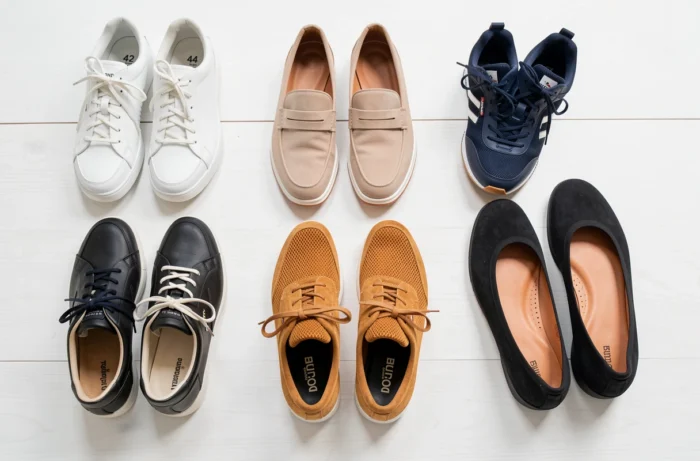
A survey of the men’s catalog from La Redoute conducted in September 2026 shows a particularly abundant supply around sizes 45 to 48. This observation may seem counterintuitive: these large sizes are not among the best-selling in volume.
The explanation lies in the commercial strategy. Online retailers inflate their catalogs in areas where physical competition is weak. A downtown store rarely stocks size 47, which drives buyers of large sizes towards e-commerce. The assortment displayed does not reflect actual sales, it reflects a competitive positioning.
What this discrepancy means for the consumer
For central sizes (40-43 for men, 37-39 for women), physical availability remains adequate in most stores. However, buyers at the extremes of the curve face two distinct problems:
- Small men’s sizes (39 and below) are often absent from adult collections and redirected to teenage ranges, with different finishes.
- Large women’s sizes (42 and above) remain marginal in the offerings of generalist brands, despite a growing demand.
- Wide feet, across all sizes, have very limited choices compared to standard feet, an angle still underexploited by retailers.
This gap between catalog and demand explains why some popular sizes are frequently out of stock while others, less in demand, remain available at all times.
Flat shoes and the evolution of popular sizes in France
The French market recorded 281 million footwear items sold in 2025, which is 11 million more than in 2024. This overall progression is accompanied by a change in the profile of the models purchased.
Sales of flat shoes increased by 18% in 2025. The decline of high heels and the rise of models oriented towards everyday comfort indirectly modify the distribution of requested sizes. A flat shoe affects the foot differently: the roll is more natural, and buyers sometimes choose a half size up compared to a heeled model.
Declared size and purchased size: an underestimated gap
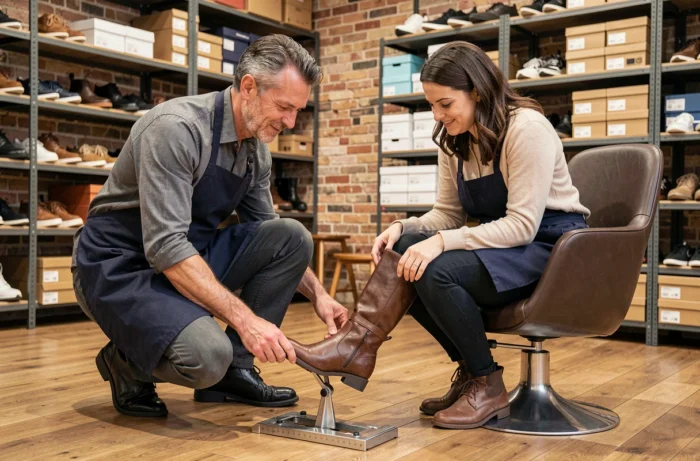
The correspondence between the size that the French think they wear and the one they actually buy is not always the same. Several factors contribute to this gap.
The French system (Paris point) assigns an interval of 6.67 mm between each size. A size 42 theoretically corresponds to a foot of 28 cm. In practice, the internal length varies from one brand to another, sometimes by several millimeters for the same displayed size. A size 42 from one brand is not necessarily the same as a size 42 from another.
This ambiguity leads some consumers to order two sizes to return the one that does not fit, a behavior that artificially inflates the volumes of certain sizes in online sales statistics.
Foot width: the absent criterion in size statistics
Rankings by size only take into account the length of the foot. Width, which is crucial for comfort, remains a blind spot in most French commercial data.
Catalog surveys online confirm this gap: the offer for wide feet is very limited compared to that for standard feet. Specialized brands exist, but they remain little visible in public search results.
This absence has a concrete effect on the perception of popular sizes. A buyer with wide feet who takes a size up to gain interior volume skews the reading of the data. Their purchased size does not correspond to the actual length of their foot, but to a compromise due to the lack of a suitable model in width.
The popularity of size 42 for men and size 38 for women remains the foundation of the French shoe market. These sizes concentrate the highest demand and structure the stock choices of distributors.
Recent developments, particularly the growth of flat shoes and the overall market increase, do not change this hierarchy but redistribute volumes among product categories. The real blind spot remains foot width, a parameter that neither sales rankings nor most retailers systematically take into account yet.