A reheated roast beef loses its pink texture and tenderness as soon as the internal temperature exceeds that of the initial cooking. The problem is physical: beyond a certain thermal threshold, muscle fibers expel their water, and the meat becomes dry, gray, and stringy. Therefore, reheating a roast beef without drying it out means precisely controlling the temperature rise to never exceed this threshold.
Vacuum Reheating of Roast Beef: The Most Reliable Method
Most guides focus on the oven, skillet, or microwave. Vacuum reheating in a regulated water bath is rarely discussed, yet it is the only technique that guarantees not exceeding the initial cooking degree.
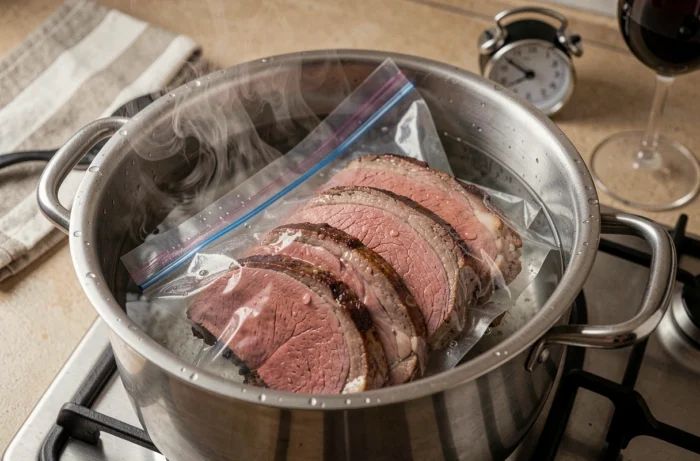
The principle is simple: the meat, placed in a sealed bag, is immersed in water maintained at a constant temperature. If the roast beef was cooked medium, the water bath is set a few degrees below this target temperature. Heat diffuses slowly and evenly, never going beyond the set point.
Several recent guides present this approach as the reference for reheating already cooked pieces. It requires a sous-vide device, but the process can be replicated manually with a kitchen thermometer and a monitored pot of water. The water should never simmer. Allow for a variable duration depending on the thickness of the piece, checking with a probe.
To delve deeper into this topic, you can find other techniques for reheating roast beef on Matin Gourmand that detail the variations in the oven and skillet.
Reheating Roast Beef in the Oven at Low Temperature Without Overcooking
The oven remains the most common tool. The difficulty is that a standard domestic oven heats by radiation and convection, which dries out the surface of the meat long before the center is warm.
Setting the Right Oven Temperature
An oven set too high (above 150 °C) causes rapid overcooking of the outer layers. An oven set low, around 120 °C, allows time for the heat to penetrate without creating a sharp contrast between the crust and the center of the roast beef.
Adding moisture in the oven limits evaporation. Two concrete options:
- Place a small container of hot water on the lower rack to create steam in the oven, which slows down the drying of the surface.
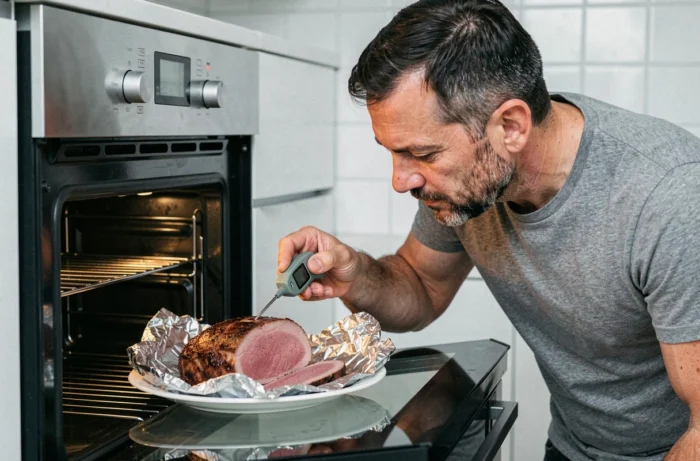
- Wrap the roast beef in aluminum foil with one or two tablespoons of cooking juice, broth, or simply water. The aluminum traps steam around the meat.
- Cover the dish with an oven-safe lid or a sheet of aluminum loosely placed to allow slight air circulation while retaining moisture.
Monitoring the Internal Temperature
Without a probe, you are working blindly. The thermal probe is the only tool that prevents overcooking during reheating. Remove the meat from the oven as soon as the center reaches the desired temperature, then let it rest for a few minutes under aluminum foil. This resting period allows for an even redistribution of residual heat.
Food Safety and Reheating Cooked Meat
Reheating a roast beef creates a direct tension between taste and safety. A roast beef served pink has an internal temperature below the recommended thresholds for reheated leftovers.
Recent French professional recommendations specify two points not to be ignored:
- Cooked meat leftovers must be stored between 0 and 4 °C in the coldest part of the refrigerator and consumed quickly.
- When reheating, a cooked dish must reach at least 63 °C at the core to be considered safe. This operation should only be performed once.
- A roast beef left at room temperature for more than two hours enters the bacterial proliferation zone and should no longer be consumed.
Reaching 63 °C at the core means exceeding rare cooking. For those wishing to maintain a pink interior, sous-vide remains the method that offers the best compromise: the meat rises in temperature evenly, and the sealed bag limits the risk of external contamination during reheating.
Microwave and Skillet: Reheating Sliced Roast Beef
The microwave is often discouraged for roast beef, and for a specific reason: it heats by agitating water molecules, which accelerates their evaporation. The result is dry meat on the surface and still cold in places.
If this is the only option available, slicing the roast beef into thin pieces changes the game. Thin slices heat faster and more evenly than a thick block. Arrange them in a circle on a plate, add a spoonful of broth or juice, cover with a microwave-safe film, and heat in short bursts at medium power rather than continuously at full power.
The skillet works on the same slice principle. A drizzle of fat in a hot skillet, slices placed for a few seconds on each side. Direct contact with the metal creates a slight Maillard reaction on the surface, which restores flavor. The risk is prolonging the contact time: beyond a few seconds per side, the meat turns gray and toughens.
What Really Changes the Final Result
The choice of method matters less than two often-neglected parameters. The first is the quality of the retained cooking juice. Coating the slices or the piece with this juice before reheating compensates for some of the water lost by the fibers. The second is the starting temperature of the meat: a roast beef taken out of the refrigerator just before reheating undergoes a more brutal thermal shock than a piece left for about twenty minutes at room temperature.
Reheating a roast beef remains an exercise in compromise between texture, flavor, and safety. The thermal probe, a low oven, or a controlled water bath, and good cooking juice kept cool are the three elements that make the difference between an appetizing leftover and cardboard-like meat.