
The banana consumed alone on an empty stomach causes a rapid glycemic spike followed by a marked drop in energy mid-morning. This observation, repeated everywhere, masks a parameter rarely exploited in popular articles: the degree of ripeness of the fruit radically changes its metabolic response.
Resistant starch and banana ripeness: the overlooked variable at breakfast
A green or barely yellow banana contains a high proportion of resistant starch. This carbohydrate does not behave like a simple sugar: it escapes digestion in the small intestine and arrives intact in the colon, where it is fermented by the microbiota. The result is a significantly more stable blood sugar level and prolonged satiety throughout the morning.
As the fruit ripens, this resistant starch converts into free sugars (glucose, fructose, sucrose). A brown-spotted banana has a significantly higher glycemic index than a banana with still firm skin. The difference is not marginal: we observe almost opposite metabolic behavior between these two stages of ripeness.
Most warnings about eating a banana for breakfast are based on a specific scenario: a very ripe banana, consumed alone, without any source of protein or fat. Step outside this scenario and the problem is considerably reduced.
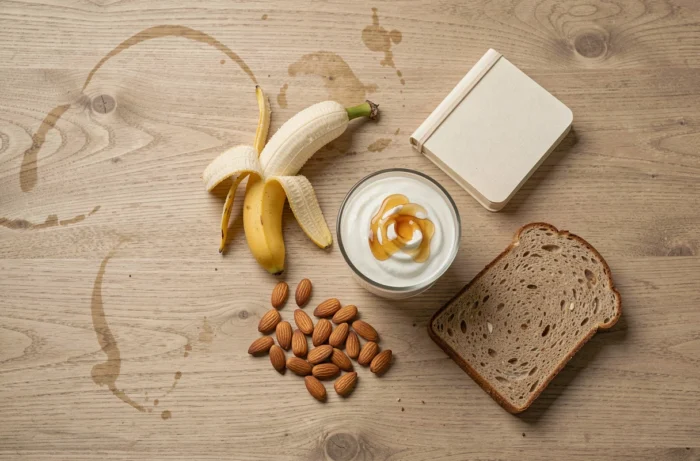
Postprandial glycemia: the banana alone versus a complete breakfast
It is the overall composition of the meal that determines the glycemic response, not an isolated food. Pairing the banana with a source of protein (yogurt, egg, nuts) and fat slows gastric emptying and mitigates the blood glucose spike.
A recent meta-analysis of several dozen randomized controlled trials confirms this principle in diabetic individuals: glycemic control depends on the whole food matrix, not on a fruit taken separately. In other words, banning the banana from the morning without reviewing the rest of the plate makes no metabolic sense.
Combinations that change the game
- Sliced under-ripe banana in oatmeal: the beta-glucans from the oats add an additional barrier to sugar absorption, and the resistant starch from the banana nourishes the colonic microbiota.
- Mashed banana on whole grain toast with almond butter: the fats from the almond and the fibers from the whole grain bread lower the glycemic load of the entire meal.
- Blended banana in a smoothie with cottage cheese and chia seeds: the proteins from the cottage cheese and the mucilaginous fibers from the chia slow digestion and prolong satiety well beyond ten in the morning.
In each of these cases, the banana acts as a gradual energy provider, provided it is not left to bear the carbohydrate load of the meal alone.
Potassium and microbiota: what the banana really brings in the morning
The nutritional angle goes beyond just the sugar question. The banana is one of the most accessible sources of potassium on a daily basis. This mineral plays a role in regulating blood pressure and muscle contraction, two functions that are activated right upon waking.
Potassium is also an electrolyte lost during sleep through nighttime sweating. Replenishing it at the first meal has a real physiological interest, especially for active individuals or those who train in the morning.
Moreover, the prebiotic fibers of the under-ripe banana nourish the beneficial bacteria in the colon. Recent publications in gastroenterology highlight that resistant starch promotes the production of butyrate, a short-chain fatty acid that protects the intestinal lining. This prebiotic effect is maximal with a green banana and almost nonexistent with a very ripe banana.

Banana for breakfast: at what stage of ripeness to consume it
We recommend choosing the fruit based on the desired goal. The following table summarizes the logic:
| Ripeness | Characteristics | Breakfast Use |
|---|---|---|
| Green, firm skin | Rich in resistant starch, low sweetness, firm texture | Stable glycemia, maximal prebiotic effect, long satiety |
| Yellow without spots | Balance of starch/sugars, sweet flavor | Good compromise between taste pleasure and glycemic control |
| Spotted, brown | Starch almost completely converted to free sugars | Rapid glycemic spike, must be paired with proteins and fats |
The riper the banana, the more non-negotiable the protein and fat accompaniment becomes. A brown banana eaten alone reproduces exactly the scenario that dietitians criticize, rightly so.
And the banana in a fruit bowl or an acai bowl?
Trendy fruit bowls often combine ripe banana, mango, sweet granola, and honey. The simple sugar load of this type of preparation far exceeds that of a banana alone. The problem is no longer the banana, but the complete absence of glycemic restraint on the plate.
Replacing industrial granola with unsweetened oatmeal and adding a spoonful of peanut butter is enough to transform the metabolic profile of the meal.
The banana is not a food to be banned from breakfast. The real lever is the choice of ripeness and the systematic presence of proteins and fats in the same meal. Excluding the banana from the morning without understanding these two parameters is akin to treating a symptom without identifying the cause.