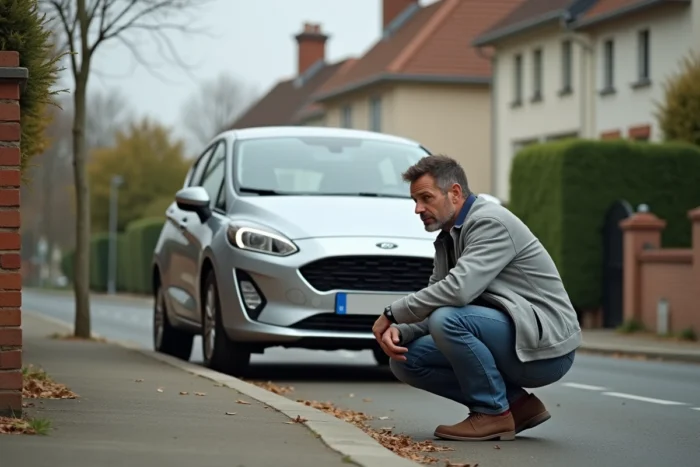
In residential subdivisions, the sidewalk that runs along the facade often gives the impression of being part of the property. The border is maintained by the resident, sometimes even financed during the construction of the lot. This proximity creates a persistent confusion about the right to park a vehicle there. However, the applicable legal framework does not take this impression of ownership into account.
Sidewalk in a subdivision: public domain or private land
The fundamental distinction lies in the land status of the sidewalk. In a subdivision where the roadways have been transferred to the municipality (the most common case after the completion of the works), the sidewalk belongs to the municipal public domain. The adjacent property owner retains a right of access to their parcel, but no right of occupation.
Even when the roadway remains private (non-transferred subdivision), the subdivision regulations almost always require each owner to park on their own land. Turnaround areas, grassy strips, and internal sidewalks are common spaces managed by the free union association (ASL) or the free urban land association (AFUL).
Before considering parking on a sidewalk in front of one’s home in a subdivision, it is necessary to check both the status of the roadway and the subdivision’s specifications. These two documents accumulate without replacing each other.
A point often overlooked: the obligation to maintain the sidewalk by the adjacent property owner (snow removal, weeding) does not confer any right of private use. Maintaining is not occupying.
Article R417-11 of the Highway Code: the prohibition and its limits
Article R417-11 of the Highway Code classifies parking on a sidewalk as inconvenient parking. This prohibition aims to protect the movement of pedestrians, people with reduced mobility, and strollers. It applies equally in front of a building in the city center and in front of a house in a subdivision.
The text does not provide for any exception related to the status of being an adjacent property owner. Living across from the sidewalk does not create any derogatory rights. However, the mayor can issue a municipal order allowing parking on part of the sidewalk, provided that the remaining width allows for pedestrian passage (generally a minimum of 1.40 m). Such orders remain rare in subdivisions because sidewalks there are often narrower than on main roads.
Sanctions applicable in case of parking on the sidewalk
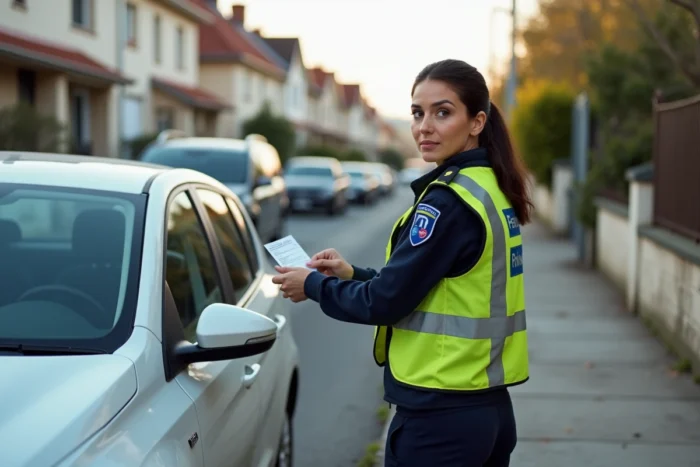
Ticketing falls under the municipal police or public road surveillance agents. The infraction is penalized by a fixed fine of class 2. In case of a manifest danger or characterized obstruction, the vehicle may be towed at the owner’s expense.
Ticketing does not require a prior complaint from a neighbor. An agent who observes the infraction during a patrol can issue a report on their own initiative.
Abusive parking on subdivision roadways: the 72-hour rule
Some municipalities have issued orders specifying that a vehicle immobilized for more than 72 hours in the same free space constitutes abusive parking, even when it is properly parked on the roadway. This measure targets residential streets and subdivision entrances where vehicles remain parked for weeks.
The distinction is significant. A vehicle parked on the roadway (and not on the sidewalk) in front of a house in a subdivision does not commit an infraction of inconvenient parking. However, it may fall under abusive parking if the municipality has issued an order to that effect and the time limit has been exceeded.
- Parking on the sidewalk: immediate infraction, regardless of the time limit, subject to ticketing as soon as observed.
- Parking on the roadway beyond the time limit set by municipal order: infraction of abusive parking, which requires a timestamped observation.
- Parking in a common area of the private subdivision in violation of the regulations: civil dispute between the owner and the ASL or co-owners, not a criminal infraction.
Mayor’s police power and residents’ recourse
The mayor holds the traffic police power on municipal territory, including on roadways of transferred subdivisions. They can issue an order prohibiting parking on certain sections, install signage, or order towing.
In private subdivisions where the roads have not been transferred, the mayor retains their police power for public safety reasons. Parking that blocks access for emergency vehicles or reduces visibility at an intersection may justify municipal intervention, even on a private road open to public traffic.
Challenging the inaction of the municipality
When the mayor refuses to act despite repeated reports, residents have administrative recourse. A formal notice sent to the mayor by registered mail constitutes the first lever. In case of an explicit refusal or prolonged silence, an appeal to the administrative court may compel the municipality to exercise its police power.
Case law recognizes that the refusal to exercise police power constitutes a fault when the disturbance is characterized and intervention is materially possible. Field reports vary on this point: some municipalities react after a simple report, while others remain passive even in the face of documented situations.
- First step: report in writing to the municipality, precisely describing the situation (photos, dates, observed disturbance).
- Second step: if the mayor does not respond within two months, their silence constitutes an implicit decision of rejection.
- Third step: bring the case to the administrative court to challenge this refusal, demonstrating the disturbance to public order.

Parking on the sidewalk in a subdivision remains an infraction, whether the sidewalk is public or the subdivision regulations explicitly prohibit it. Proximity to one’s home does not alter the legal framework.
Only a municipal order can create a local exemption, and such orders are infrequent in residential areas. For residents facing recurring vehicles on the sidewalk, the most direct lever remains written reporting to the municipality, followed by administrative recourse if the response is delayed.