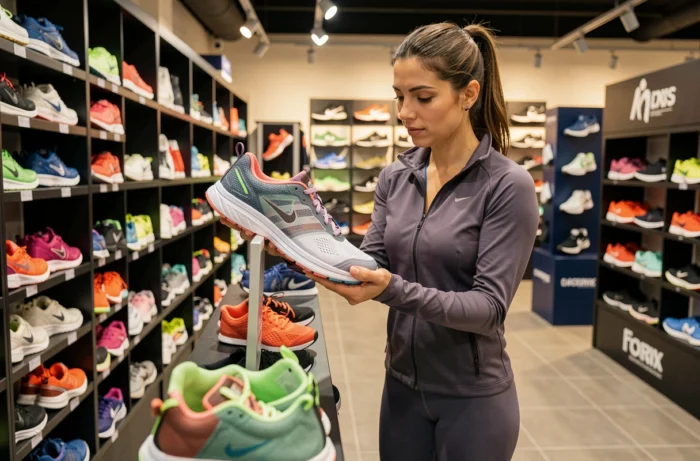
The sports equipment market has become significantly denser in recent years, with a proliferation of ranges, embedded technologies, and marketing promises. Faced with this overwhelming offer, choosing one’s equipment is less about an impulse purchase and more about a process of analysis. Making the right choice in sports equipment requires understanding what in a product represents real gain and what is superfluous.
Repairability and lifespan: what regulations change for sports equipment
One aspect rarely addressed in traditional buying guides concerns the regulatory framework that now surrounds the design of equipment. In France, sports articles are integrated into extended producer responsibility (EPR) schemes, with an obligation to provide spare parts for at least five years for certain categories, notably equipment similar to bicycles.
This evolution, stemming from the AGEC and Climate and Resilience laws, concretely modifies the criteria for choice. An elliptical bike, a home trainer, or a pair of rollerblades with non-replaceable components represent a risk of rapid obsolescence.
Before purchasing, checking if the manufacturer commits to providing spare parts allows for an assessment of the product’s actual durability. Browsing sports equipment on H2O Sport gives an idea of the ranges that incorporate this longevity logic into their design.
Sports shoes: adapting the choice to foot biomechanics
Shoes represent the equipment category where the gap between a good and a bad choice is felt most directly. For running, the type of stride, training frequency, and foot morphology determine the suitable model, much more than the brand or design.
A pronator runner has different support needs than a neutral runner. Cushioning, often highlighted in advertisements, does not compensate for a poor foot strike. Field feedback varies on this point: some practitioners achieve better results with minimalist shoes, while others need enhanced cushioning to avoid joint pain.
Concrete criteria for selecting a suitable pair
- The drop (difference in height between the heel and the forefoot) should match your natural stride, not a current trend. A high drop suits heel strikers, while a low drop is better for midfoot runners.
- The sports shoe size often differs from everyday shoe size: planning for an extra half size prevents black toenails and blisters on long distances.
- The grip of the outsole varies depending on the surface used (road, trail, gym). A versatile sole exists, but it will always be a compromise.
Investing time in trying on shoes at the end of the day (when the foot is slightly swollen) remains the most reliable method to validate a choice.
Sports textiles: beyond comfort, real technical constraints
The choice of sports clothing is not limited to aesthetics. An unsuitable textile causes chafing, overheating, or excessive cooling, three factors that directly degrade performance and increase the risk of injury.
Synthetic fibers wick away sweat more effectively than cotton, which absorbs moisture and weighs down the garment. For endurance sports practiced outdoors, layering (breathable base, insulating layer, waterproof layer) allows adaptation to temperature variations without interrupting effort.
The specific case of sports bras
For female athletes, the sports bra represents a technical piece of equipment in its own right. Insufficient support during high-impact activities (running, team sports) stresses the Cooper’s ligaments, which can lead to chest pain and lasting discomfort. The level of support should correspond to the intensity of the activity, not a one-size-fits-all criterion.

Connected equipment: measurable gains or unnecessary complexity
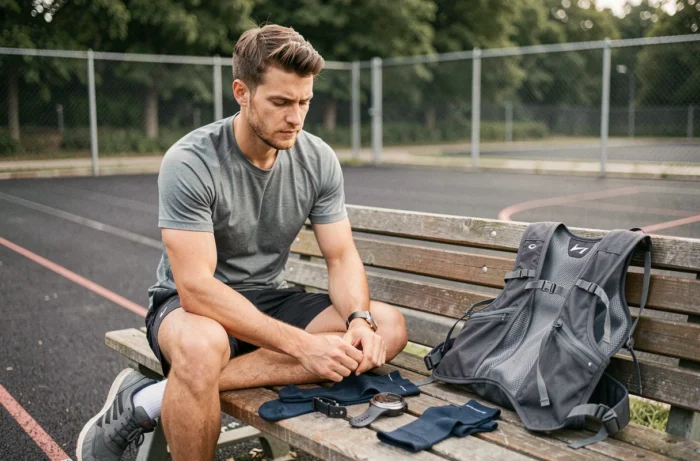
Connected objects dedicated to sports have seen sustained growth since 2024, driven by GPS watches and heart rate sensors. The promise is clear: measure effort to better manage it.
In practice, a reliable heart rate monitor allows for real-time adjustment of training intensity, identification of aerobic and anaerobic work zones, and detection of emerging overtraining. For a regular runner or cyclist, the available data confirms a real interest in tracking progress.
Limits appear when the accumulation of data replaces listening to the body. An occasional practitioner does not necessarily need a power sensor or heart rate variability analysis. The usefulness of a connected object depends on the regularity of practice and the ability to interpret the data.
What deserves investment and what can wait
- A watch with GPS and optical heart rate covers the needs of most regular athletes, from running to cycling to open water swimming.
- Power sensors (crank, insoles) are aimed at practitioners who follow a structured training plan and know how to utilize these metrics.
- Connected scales and sleep trackers provide useful supplements, but their reliability varies greatly from model to model.
Choosing sports equipment to improve performance starts with a clear identification of real needs. Equipment well-suited to one’s morphology, level of practice, and current regulations on durability yields more tangible results than a purchase driven by novelty. The best equipment is the one that matches your current practice, not the one you imagine having in six months.