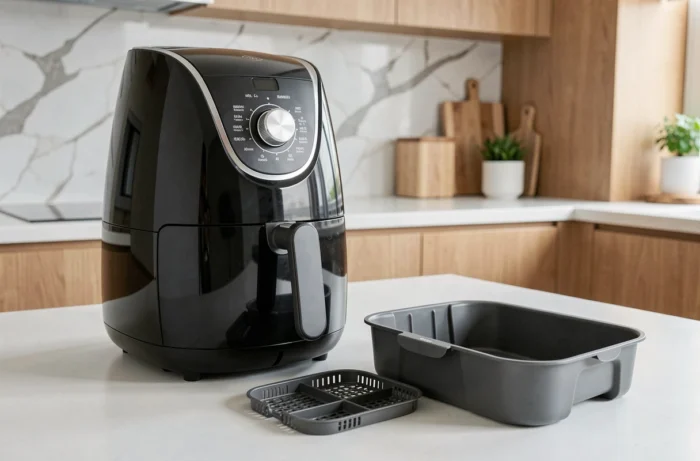
The dishwasher compatibility of a fryer is not just a marketing mention on a package. The product sheets of many manufacturers state “removable bowl” without specifying whether this bowl, the basket, or the lid are actually dishwasher safe.
The Fnac product sheet for a Steba fryer with a removable bowl explicitly mentions “dishwasher compatible: not communicated,” even though the bowl is presented as a maintenance advantage. Identifying models whose parts are documented as compatible therefore requires a verification effort that general guides tend to overlook.
Dishwasher compatibility of fryers: what product sheets don’t say
The problem is structural. In 2026, dishwasher compatibility is still not considered by all manufacturers as a criterion to document on par with power or capacity. As a result, there are bowls, baskets, and grills described as “removable” or “easy to clean” without any mention of being dishwasher safe.
When information exists, it is often partial. A manufacturer may indicate that the basket is compatible without specifying whether the lid or the bowl are also compatible. We recommend checking each part for dishwasher compatibility before any purchase, by consulting the technical manual rather than the commercial sheet.
Choosing a fryer easy to clean with a dishwasher requires cross-referencing multiple sources, as the promise of simplified maintenance displayed in the showcase does not always cover the reality in the kitchen.
PFAS-free coatings and dishwasher compatibility: a technical compromise
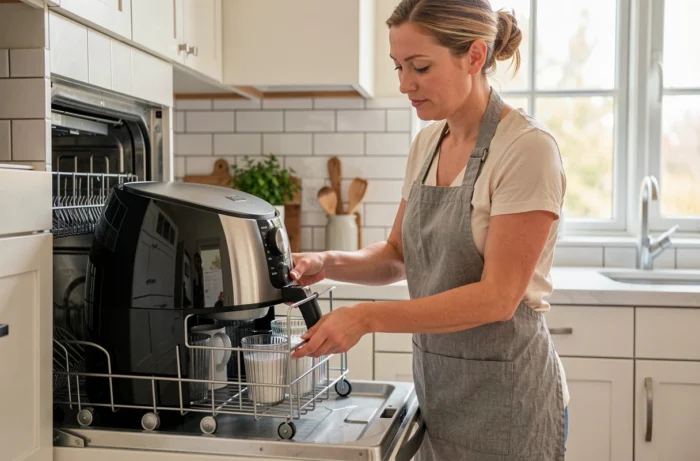
The shift towards PFAS-free coatings is a fundamental trend among fryer and air fryer manufacturers. This change addresses health and regulatory concerns, but it raises a technical question rarely discussed: does the new coating withstand repeated dishwasher cycles?
Classic PTFE-based non-stick coatings generally withstood the temperatures and detergents of the dishwasher. Ceramic or PFAS-free alternatives do not all exhibit the same mechanical resistance. An intensive high-temperature cycle can degrade a ceramic coating more quickly than a traditional fluorinated coating.
Some recent models explicitly maintain dishwasher compatibility despite the shift to PFAS-free. This is an emerging selling point, particularly in the air fryer segment. We observe that dishwasher compatibility is becoming a differentiating criterion for PFAS-free air fryers, where it was previously considered a given for classic coatings.
Points to check before the first cycle
- Consult the manual to identify compatible parts: basket, bowl, grill, lid. Each element may have a different status.
- Prefer the delicate cycle (low temperature, no intensive drying) for ceramic coatings, even if the manual allows for dishwasher use.
- Check for the absence of silicone parts or non-removable seals that could degrade when in contact with detergent.
Stainless steel basket air fryers: the most reliable option for the dishwasher
Air fryers equipped with stainless steel baskets represent a radical alternative to non-stick coatings. Stainless steel does not degrade in the dishwasher, does not release any chemical compounds, and retains its properties cycle after cycle. In terms of maintenance, it is the most durable material.
The compromise lies elsewhere. Without a non-stick coating, food tends to stick more, especially breaded preparations or sweet marinades. A prior soak of a few minutes is often necessary before placing it in the dishwasher.
On the other hand, stainless steel tolerates aggressive detergents and intensive cycles without performance loss. For daily use where dishwasher cleaning is systematic, it is the most consistent choice in the long term.
Oil fryers with filtration: easier cleaning but variable compatibility
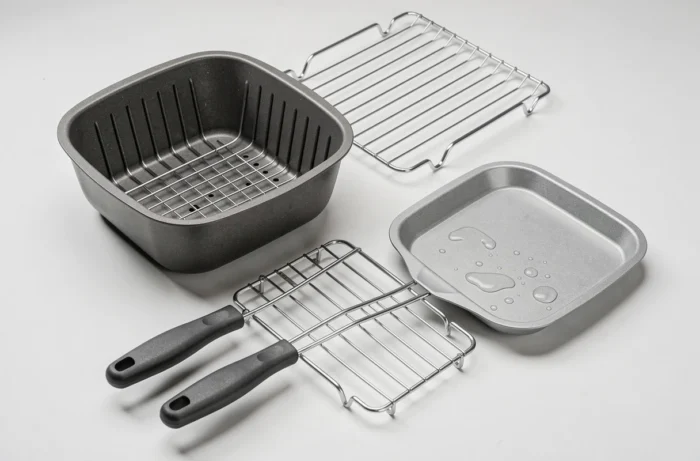
Traditional oil fryers with an automatic filtration system, like the Tefal Oleo Clean, simplify maintenance by separating used oil from food residues. The filtration system reduces the frequency of draining and limits the fouling of the bowl.
The dishwasher compatibility of these models mainly concerns the basket and sometimes the lid. The bowl itself, in constant contact with hot oil, often requires manual cleaning to remove greasy deposits that the dishwasher does not always dissolve effectively.
In this segment, we recommend distinguishing between two levels of maintenance: routine cleaning (basket in the dishwasher after each use) and deep cleaning (bowl by hand, with degreaser, every five to ten cycles depending on usage intensity).
Criteria for choosing an easy-to-maintain oil fryer
- Removable bowl with documented dishwasher compatibility in the manual, not just on the commercial sheet.
- Integrated filtration system to reduce the frequency of complete cleaning.
- Removable lid: a fixed lid accumulates greasy splashes and can only be cleaned with a sponge, which partially negates the time-saving benefit of the dishwasher.
- Cold zone under the heating element to trap food residues and prevent them from burning at the bottom of the bowl.
Double zone models and cleaning: two drawers, two dishwasher loads
Double zone air fryers (like the Ninja DualZone) appeal for their versatility: two simultaneous cooking processes at different temperatures. In terms of maintenance, each drawer and its basket are separate parts, generally dishwasher safe.
The often-overlooked point is the bulk. Two drawers take up two spaces in the dishwasher, which can be problematic in a standard appliance that is already loaded. On a model like the Ninja DualZone, the total capacity approaches ten liters, and the baskets are not compact.
For daily family use, this format remains relevant as long as you anticipate the cleaning logistics. A dedicated cycle for cooking accessories, launched at the end of the day, avoids cluttering the regular dishes.
The choice of a dishwasher-compatible fryer relies less on label promises and more on the concrete verification of materials and parts documented as compatible. Stainless steel offers the best durability in the dishwasher, PFAS-free coatings are progressing but require vigilance, and oil fryers with filtration remain a compromise between mechanical and manual cleaning. The technical manual remains the only reliable document to make a decision.