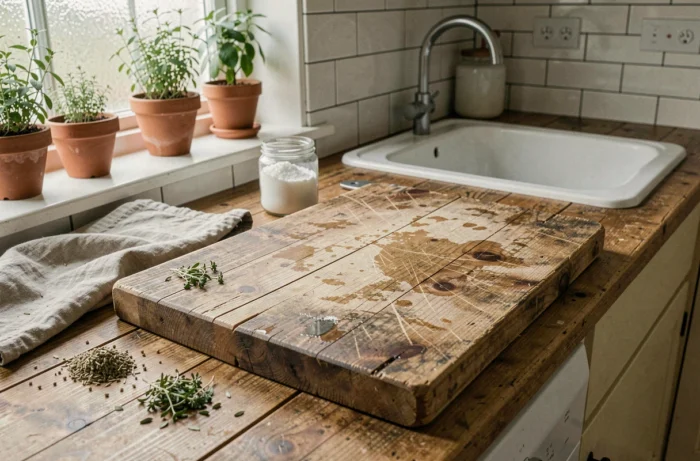
A wooden cutting board always ends up wearing out. Deep grooves, warped surface, persistent odors: the moment arrives when it no longer fulfills its role in the kitchen. The question of sorting then arises, because the wood of a cutting board does not fall into the usual categories of household waste. Depending on whether it is raw, oiled, or treated, the recycling pathways differ.
What makes a cutting board difficult to sort
Untreated solid wood (beech, maple, bamboo) can be recycled without major difficulty. It falls into the category of so-called class A woods, meaning raw, dry woods without paint or chemical treatment.
The problem is that a cutting board is almost never made of completely raw wood. Most are coated with food-grade mineral oil or food-safe varnish. Others combine wood with resin, wood with non-slip silicone, or incorporate metal elements (screws, hinges for folding models).
These additions, even minimal, complicate sorting. A board with a coating or non-wood inserts may be reclassified as class B wood (lightly treated). If you don’t know where to recycle a cutting board in your municipality, the recycling center remains the most reliable solution for proper sorting.
On-site agents direct the wood to the appropriate bin based on its condition. Placing a treated board in a home composter or in the green waste bin would be a mistake, as surface treatments contaminate the compost.
Recycling center, compost, or trash: which pathway for which state of board
The appropriate pathway directly depends on the nature of the wood and what it has undergone over the years of use.
Raw untreated wood board
If the board has never received oil, varnish, or visible glue, two options are available. Composting works, provided it is cut into small pieces to speed up decomposition. The recycling center also accepts it in the clean wood bin.
In very small quantities, ADEME indicates that a piece of untreated and uncontaminated wood can go into the household waste bin. This solution remains a last resort.
Oiled or varnished board
An oiled board never goes to compost. Mineral oil, even food-grade, is not an organic product decomposable by soil microorganisms. Head to the recycling center, class B wood bin.
Composite board or with inserts
Some boards combine wood and synthetic materials. They fall under bulky waste or, depending on the municipality, a specific collection. Removing non-wood elements (rubber feet, plastic handle) before dropping off facilitates the recycling of the wood part.
- Untreated raw wood: home compost or clean wood bin at the recycling center
- Oiled, varnished, or painted wood: recycling center only, treated wood bin
- Wood with metal or plastic inserts: remove non-wood elements, then recycling center or bulky waste
Extending the life of a board before thinking about recycling
Wood recycling is a last step. Before reaching that point, a wooden cutting board can often be restored or repurposed.
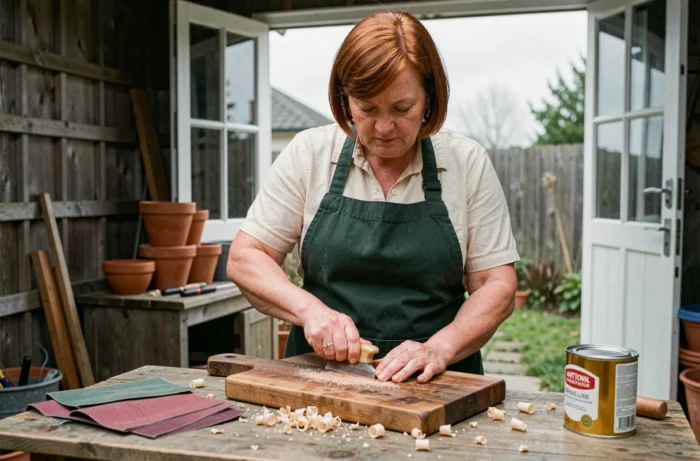
Sanding with medium-grit sandpaper is enough to erase superficial grooves. The damaged surface layer is removed, then a food-grade vegetable oil (linseed, walnut) is applied to nourish the wood. This operation gives several more years of service to a board that seemed ready for disposal.
If the board is too damaged for food use, it can still serve as a support for DIY or decoration. Presentation tray for cheeses, base for plants, rustic trivet: the thick wood of a cutting board lends itself to many repurposings without any complex transformation.
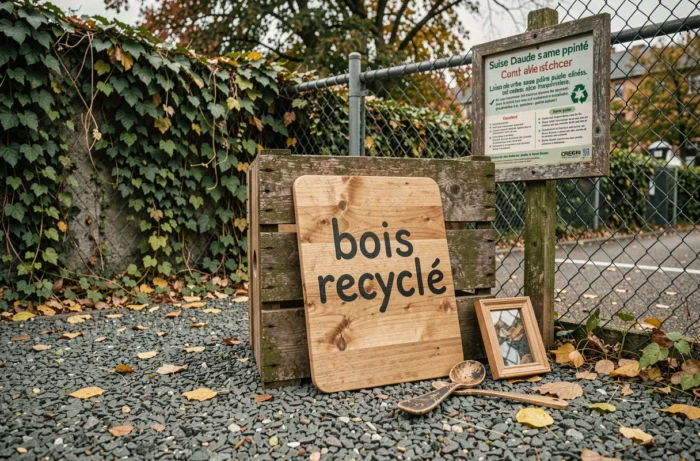
Wood recycling at the recycling center: what happens after drop-off
Once dropped off at the recycling center, the wood follows a multi-step process. It is first visually sorted to separate clean wood from treated wood. Then comes shredding, which reduces the pieces into chips or flakes.
Class A woods are used to make particle boards used in furniture or construction. Class B woods, more often directed towards energy recovery, fuel biomass boilers. In both cases, the material does not end up in a landfill.
For class C woods (treated with hazardous products, such as creosote wood), the pathway is specific and involves controlled incineration. A domestic cutting board almost never falls into this category.
The real lever: buying a board that lasts
The question of recycling loses its weight when the board lasts a long time. A hardwood with tight grain like maple or walnut withstands cuts much better than a softwood like pine. Bamboo, often presented as eco-friendly, poses a glue problem: most bamboo boards are made of glued strips, complicating their recycling at the end of life.
Choosing a solid, certified hardwood board without chemical surface treatment simplifies the entire chain. The day it reaches the end of its life, it can go to compost or the clean wood bin without hesitation.
- Prefer hardwoods (maple, beech, walnut) over softwoods or glued composites
- Avoid boards with synthetic coatings or integrated plastic feet
- Regularly maintain with food-grade vegetable oil to delay replacement
The sorting gesture for a wooden cutting board remains simple when the exact nature of the material is identified. The recycling center handles the vast majority of cases. Compost is only valid for confirmed raw wood. And the best strategy remains to delay as much as possible the moment when the board leaves the kitchen.