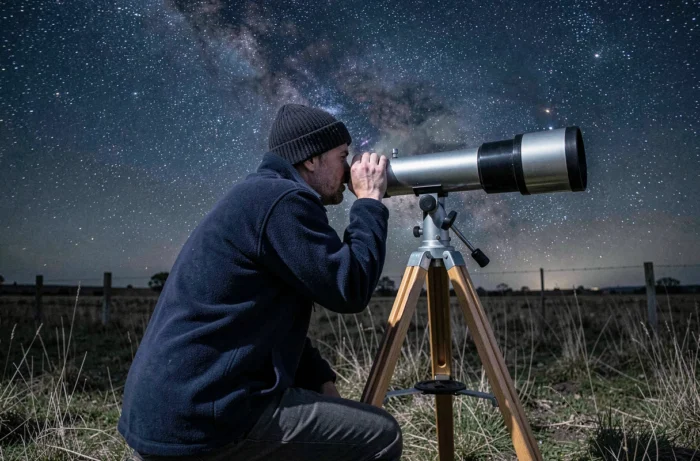
We arrive at the site on a summer evening, look up, and the first question arises: should we buy a telescope right away or start with our hands in our pockets? The answer depends on what we actually want to observe. A hasty purchase remains the primary cause of disappointment in amateur astronomy, and most instruments that end up in the closet after three outings were chosen without a clear objective.
Observe with the naked eye before investing in astronomy equipment
The common reflex is to look for a telescope from the very first days. We skip a step. Before aiming at anything through an eyepiece, we need to know where to point.
Learning to read the sky with the naked eye changes everything for what comes next. Spotting the Big Dipper, tracing the line to the North Star, identifying the Summer Triangle or the Orion constellation depending on the season is the foundation. Without this recognition, even a good telescope becomes frustrating because we don’t know where to direct it.
Two tools are sufficient for this phase: a rotating star chart (a cardboard disk that costs a few euros) and a mobile app for stargazing. We set the date and time, orient the chart facing south, and start associating what we see above us with the printed constellations.
In just a few evenings, we gain independence. We can distinguish a planet from a star by its stable brightness, and we spot the Milky Way if the site is dark enough. The catalogs and tutorials available on astronomic.fr also help structure this gradual learning without getting lost in the mass of information.
This stage ideally lasts a few weeks. It costs nothing and already filters desires: we know if we want to closely observe the Moon, track planets, or photograph nebulae.

Astronomy club or binoculars: which first step based on your goal
An article from La Voix du Nord reports the advice of a club speaker: it’s better to start in a club rather than buy equipment right away. This practical advice deserves to be nuanced based on what one is looking for.
Simple discovery of the night sky
For a contemplative approach, without technical ambition, joining a local club remains the best possible investment. We test different instruments during collective observation evenings. We discover if a Dobson, a refractor, or a Schmidt-Cassegrain suits our way of observing. And we avoid blind purchases.
Clubs also organize outings to dark sites, far from light pollution. This is a dimension that is often underestimated when starting out from one’s garden in the city.
Targeted planetary observation
If the Moon, Jupiter, and Saturn are the priority targets, a pair of binoculars constitutes a true first instrument. 10×50 binoculars (10x magnification, 50 mm aperture) already reveal lunar craters, Jupiter’s moons, and the brightest star clusters.
- The 10x magnification offers a wide field without excessive shaking, provided you brace your elbows on a support or sit down
- The 50 mm aperture captures enough light for bright solar system objects and the most accessible double stars
- The weight remains manageable for extended observation, unlike 15×70 binoculars which require a tripod
Well-chosen binoculars serve for years, even after purchasing a telescope, for quick spotting or wide-field observation of the Milky Way.
Astrophotography from the start
Astrophotography completely changes the game. Feedback varies on this point, but most experienced practitioners advise against diving in without first observing visually for several months. The reason is technical: astrophotography requires a motorized equatorial mount, precise tracking, and software image processing. The budget and learning curve are unrelated to visual observation.
For those who still want to give it a try early on, a camera on a fixed tripod with a few seconds of exposure already allows capturing star trails or the Milky Way. It’s a good test of motivation before investing in a GoTo mount and a telescope dedicated to photography.
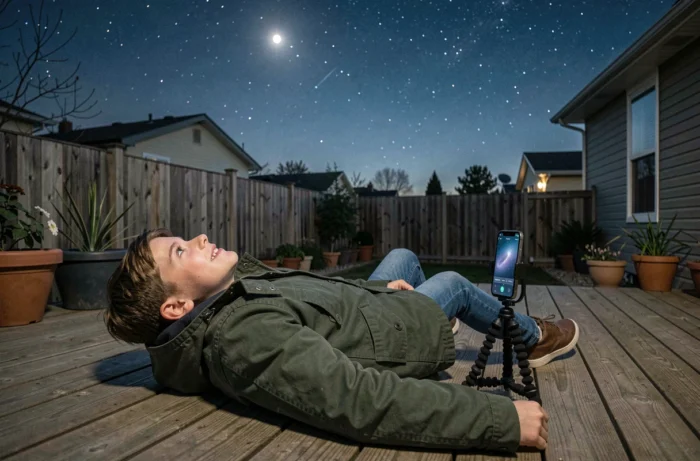
Field conditions: what makes the difference between seeing and not seeing
Three factors determine the quality of an observation: eye adaptation, site choice, and atmospheric stability.
Dark adaptation takes at least twenty minutes. Checking a phone screen in full brightness, even briefly, cancels this process. A red-filter headlamp preserves night vision while allowing you to handle charts and equipment.
The choice of site weighs as heavily as the choice of instrument. A city center sky will never show a galaxy, regardless of the telescope’s aperture diameter. Areas classified as starry sky reserves, or simply the countryside an hour’s drive away, transform the experience.
- Checking the weather is not enough: humidity, even without visible clouds, creates a veil that dims faint objects
- Atmospheric turbulence (the “seeing”) degrades planetary images. Observing at altitude or after a night of stable wind improves clarity
- A stable, flat ground avoids vibrations transmitted to the tripod, especially with a high-magnification instrument
Site preparation, eye adaptation, and reading turbulence condition the result as much as the equipment itself.
Choosing your first telescope: aperture, mount, and common traps
When the time to buy arrives, one criterion dominates all others: the aperture diameter determines what the instrument can reveal. The larger the aperture, the more light is captured, and the more faint objects (nebulae, galaxies) become visible.
The mount is as important as the optical tube. An unstable mount renders a good telescope unusable. Dobsons offer a price-to-aperture ratio that is hard to beat for visual observation. Equatorial mounts are better suited for those aiming for photography, thanks to their tracking capability.
The most common trap for beginners: relying on the magnification displayed on the packaging. A magnification of 600x on a small instrument produces only a blurry and dark image. It’s the aperture that sets the maximum useful magnification, not marketing.
The eyepiece included with an entry-level telescope is often mediocre. Planning for an additional intermediate focal length eyepiece significantly improves comfort and image quality, for a moderate cost.
A compact instrument that is quick to set up will be used three times more often than a bulky tube that stays in its box. The ease of setup conditions the regularity of outings, and it’s regularity that leads to progress.