
After several months, sometimes several years of sick leave due to burnout, the question of disability eventually arises. The treating physician or psychiatrist mentions a category 2 disability, the CPAM summons you for an examination, and questions accumulate: what conditions must be met, what amount can be expected, how to coordinate this pension with a possible return to work?
Burnout and disability: a legal distinction to understand before any steps
Before discussing the pension, it is essential to clarify a point that many employees discover late. Category 2 disability pertains to a non-work-related incapacity in the sense of Social Security. In other words, the CPAM treats your case as an ordinary illness, not as an occupational disease.
Are you wondering why this distinction matters? Because it changes the administrative circuit, the contacts, and the amounts involved. If your burnout is recognized as an occupational disease (through the CRRMP, the regional committee for the recognition of occupational diseases), you fall under a different compensation scheme, that of the work accident/occupational disease pension.
In most cases, burnout is not recognized as an occupational disease. The employee therefore remains on standard sick leave, and it is after this extended leave that the CPAM’s medical advisor may propose a transition to disability. Understanding this mechanism allows you to anticipate your steps rather than endure them. To delve deeper into the link between category 2 disability for burnout and the rate of incapacity, several medical criteria come into play.
Access conditions for category 2 disability pension after burnout
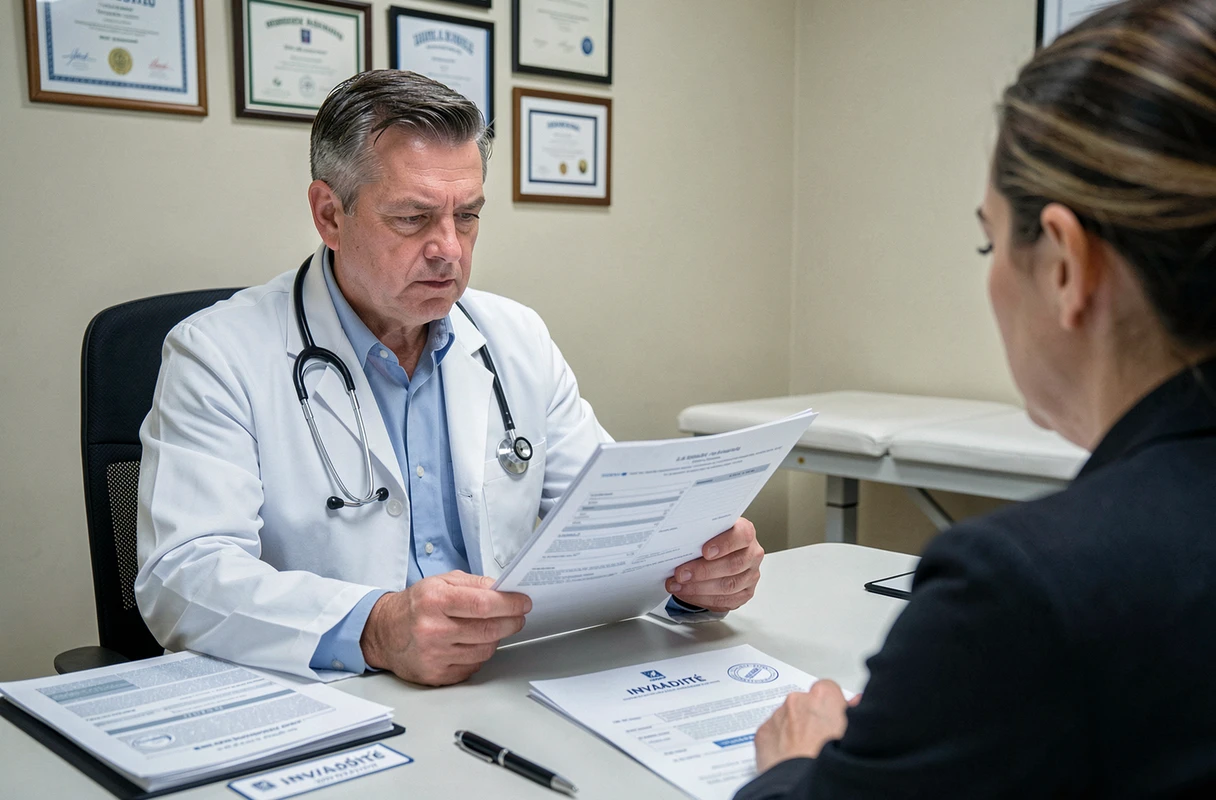
The medical advisor evaluates your condition during an examination. They do not look solely at your psychiatric diagnosis. They assess your residual earning capacity. For category 2, this capacity must be reduced by at least two-thirds.
In practical terms, this means that the medical advisor considers you to be “absolutely incapable of engaging in professional activity.” The wording is misleading: it does not prohibit you from returning to work one day; it merely states a condition at a given moment.
The criteria the medical advisor examines
- The duration and severity of your psychiatric symptoms, as attested by your psychiatrist or treating physician (ongoing treatments, possible hospitalizations, clinical evolution)
- The failure or insufficiency of treatments during the sick leave period, which shows that a return to work is not feasible in the short term
- Your affiliation conditions: having contributed sufficiently to Social Security in the months preceding the sick leave (a minimum number of hours worked or a certain amount of contributions is required)
A little-known point: the request can come from the treating physician, the psychiatrist, or the medical advisor themselves. You do not have to wait for the theoretical end of your rights to daily allowances. If your condition justifies it, your doctor can send a letter to the medical service of the CPAM to trigger the evaluation.
Amount of category 2 disability pension: calculation and ranges
The calculation is based on your average annual salary over the ten best years. The pension corresponds to 50% of this average salary, within the limit of the Social Security ceiling.
In 2026, the monthly pension ranges from 338.31 euros to 2,002.50 euros, following a 2% increase on January 1. These figures frame the reality for most insured individuals.
An example for better understanding
If your average annual salary over the ten best years is 30,000 euros gross, the gross annual pension will be 15,000 euros, or about 1,250 euros per month. This amount is subject to certain social contributions (CSG, CRDS), which reduces the net received.
For employees with modest incomes, a minimum of 338.31 euros per month is guaranteed. This guarantee prevents situations where the pension would be negligible.
Working while on category 2 disability: what is actually possible
Category 2 does not mean a permanent prohibition on working. You can resume an activity, either part-time or adapted. The pension can then be combined with a salary, within certain limits.
The accumulation rule works like this: the total pension + salary must not exceed your former reference salary. If you exceed this ceiling, the pension is reduced accordingly, not eliminated.
Since 2012, the automatic exemption from job search for holders of a category 2 disability pension no longer exists. If you are registered with France Travail, you must, in principle, justify an active job search, unless a specific exemption request based on your health condition is made.

Burnout recognized as a work accident: a little-known alternative route
Burnout does not appear in any list of occupational diseases. Recognition goes through the CRRMP, a long and uncertain process. However, if your exhaustion manifested through a sudden event at the time and place of work (fainting, acute panic attack, collapse), qualification as a work accident is possible.
This route changes the financial situation. Compensation for work accidents is more advantageous: daily allowances are higher, and a pension may be paid in the case of permanent incapacity. The procedure relies on a set of objective indicators (testimonies from colleagues, initial medical certificate dated the day of the event, declaration to the employer within 24 hours).
This qualification does not replace category 2 disability but can complement it or serve as an alternative if your burnout began in a sudden and documented manner.
The journey from prolonged burnout to category 2 disability pension remains a demanding administrative path. Each case depends on the assessment of the medical advisor, the robustness of medical follow-up, and the consistency of the submitted documents. Anticipating the request with your psychiatrist, gathering medical reports, and knowing the actual amounts of the pension allows you to approach this step with less uncertainty.