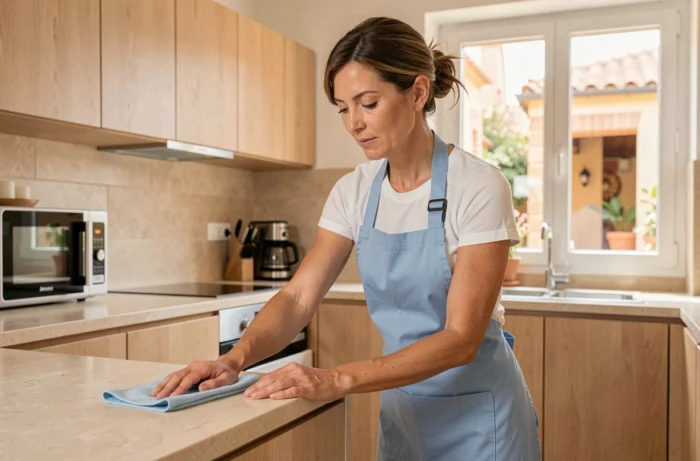
An apartment in the historic center of Nîmes, two children, a schedule balanced between the office and school: when you come home in the evening, vacuuming the dusty tiles is not the priority. It is often this gap between what we want and what we can do that drives people to look for a cleaning lady in Nîmes. Not out of excessive comfort, but because regular cleaning requires time that many Nîmes households simply no longer have.
Heat, limescale, and mistral: the cleaning challenges specific to Nîmes
It is rarely mentioned in general guides, but the Nîmes climate directly influences the frequency and type of maintenance needed. The mistral blows fine dust inside homes, even with the windows closed. In summer, high temperatures accelerate the buildup of limescale on faucets and shower walls.
The result: weekly maintenance is rarely sufficient if you want to keep the bathrooms clean. Bathrooms require regular descaling, and tiled floors (which are predominant in Nîmes buildings) quickly show dry dust. A cleaner who understands these specifics adjusts their products and techniques, whereas occasional cleaning only postpones the problem.
Homes in the historic center pose an additional challenge: limited space, narrow stairs, and lack of technical storage. Storing a vacuum cleaner, a steam mop, and cleaning products in a two-room apartment on rue de l’Aspic is like playing Tetris. Delegating cleaning to a professional equipped with their own materials frees up space as well as time.
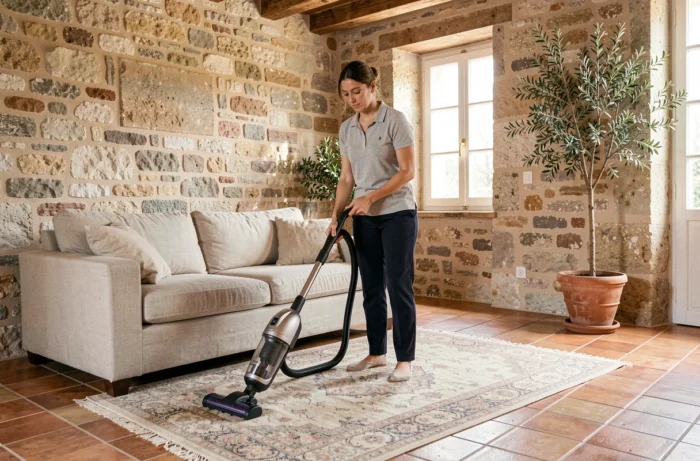
You can explore the cleaning services on E-woman to find a cleaner familiar with the specifics of Gard homes.
Tax credit for home cleaning: what the system concretely changes
The 50% tax credit on personal service expenses is often mentioned but rarely detailed in terms of its daily implications. Specifically, the spending cap reaches 12,000 euros per household per year, which can be increased based on household composition (dependent children, people over 65, disability status).
This credit applies whether you directly employ a cleaning lady or go through a declared SAP organization. The declaration is made via form 2042 RICI, under the personal services section. The 50% rate is confirmed and maintained in the consolidated tax texts in 2026.
The 50% rule on external services
A technical point that competitors often overlook: if the organization providing cleaning also charges for external services at home (shopping, accompaniment), these external expenses must not exceed 50% of the total expenses incurred at home with the same provider. Beyond that, the excess portion loses its tax advantage.
For a Nîmes household that combines cleaning and shopping assistance through the same structure, this rule changes how to organize the contract. It is better to check the distribution of billed hours before the declaration.
Direct employment or declared organization: decide based on your situation in Nîmes
The choice between directly employing a cleaner and going through a SAP company is not just a matter of price. Each option has distinct practical implications.
- In direct employment, you manage the employment contract, pay slips (via the declarative CESU), paid leave, and replacements in case of absence. The advantage: you choose the person, set the hours, and the gross hourly cost is generally lower.
- Through a SAP organization, the company handles recruitment, administrative management, and automatic replacement of the cleaner. The additional cost is justified by the total absence of administrative burden for the individual.
- The 50% tax credit applies in both cases, but immediate advance (direct payment by URSSAF to the organization) simplifies cash flow when going through a declared structure.
In Nîmes, feedback varies on this point: some households prefer the direct relationship with a trusted cleaner found through word-of-mouth in the neighborhood, while others prioritize the peace of mind of an organization that manages unforeseen events.
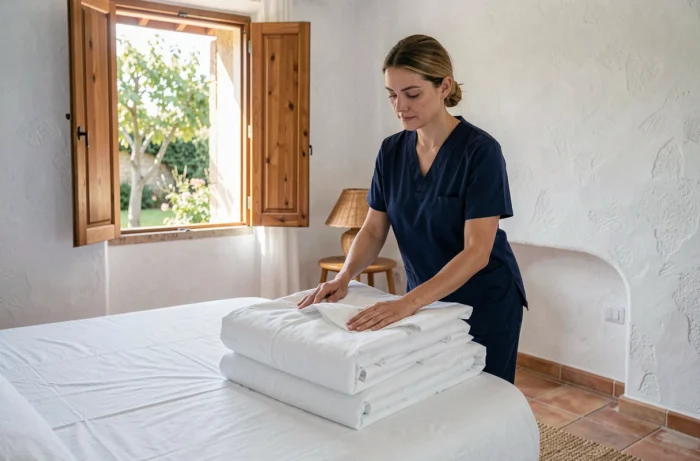
Frequency and scope of services: calibrating the right volume of hours
Requesting “cleaning” without precisely defining the scope of intervention is the primary source of disappointment. A clear specification avoids misunderstandings from the first intervention.
For a T3 apartment in Nîmes, a two-hour visit per week generally covers vacuuming the floors, cleaning the bathrooms, and the kitchen. Windows, ironing, and deep cleaning of the oven or refrigerator are additional services that are charged separately or require dedicated time slots.
Tasks often forgotten in the initial quote
- Descaling of tile joints, particularly affected by the limescale in the Nîmes water supply
- Dusting of roller shutters and blinds, which are dirty from the wind
- Cleaning of baseboards and the tops of high furniture, areas that regular maintenance systematically neglects
Specifying these tasks from the outset allows for a realistic volume of hours to be set. Underestimating the necessary time degrades the quality of service and generates frustration on both sides.
Checking the reliability of a cleaner in Nîmes: concrete criteria
Beyond online reviews, a few simple checks make a difference. Asking whether the cleaner or the organization has an active SAP declaration (verifiable on the Gard prefecture website) ensures eligibility for the tax credit. Without this declaration, no tax advantage is possible.
Professional liability insurance protects in case of breakage or accidental damage. In direct employment, it is the homeowner’s insurance that takes over, but the coverage is often more limited.
A first trial of one to two hours, paid normally, allows for evaluating the thoroughness of the work, punctuality, and communication. This is more reliable than a phone interview and requires little commitment.
Home cleaning in Nîmes responds to well-identified local constraints: climate, type of housing, water quality. Choosing the right option, verifying the tax framework, and setting a clear scope from the start transforms an expense into measurable time savings, week after week.