
A liver function test shows gamma-GT levels above the normal range, we don’t drink or drink very little, and the doctor’s first reaction is often to ask if we are sure about our alcohol consumption. This situation is common and unsettling. An elevated gamma GT level without alcohol, however, points to well-identified avenues, provided we dig deeper than the reflex “alcohol = liver”.
To better understand the causes of a high ggt 68, we must first accept that this enzyme reacts to many other aggressions besides ethanol. The liver endures dietary excesses, medication treatments, and metabolic disorders with the same discretion, until a blood test reveals the problem.
Metabolic liver steatosis: the most underestimated cause of elevated gamma GT
In a general practice setting, the typical scenario looks like this: a slightly overweight patient, with no notable alcohol consumption, presents with moderately elevated gamma-GT levels over several tests. An abdominal ultrasound eventually shows a “shiny” liver, a sign of fat accumulation in hepatocytes.
This picture now has a new name. Scientific societies (EASL, AASLD, APASL) have officially replaced the terms NAFLD and NASH with MASLD and MASH, to refocus the diagnosis on cardiometabolic risk factors: abdominal obesity, type 2 diabetes, dyslipidemia, insulin resistance.
One can be affected without being overtly obese. Patients with apparently normal weight but presenting with a high waist circumference or early metabolic syndrome fall into this category. Gamma-GT is included as a marker of hepatocellular injury in recent recommendations, alongside the transaminases ALAT and ASAT.

The key point to remember: metabolic liver steatosis is the leading non-alcoholic cause of elevated gamma-GT in Europe. A lipid profile, fasting blood sugar, and liver ultrasound are often sufficient to make the diagnosis. Waiting for the liver to “speak” more is allowing a silent inflammation to settle in.
Common medications and gamma GT: often ignored interactions
One rarely thinks of their medication box when reading a gamma-GT result. This is a mistake. Several widely prescribed therapeutic classes cause a sometimes significant elevation of this enzyme, without any serious liver injury being involved.
The most documented molecules for this effect include:
- Antiepileptics (carbamazepine, phenytoin, phenobarbital) stimulate gamma-GT production through hepatic enzymatic induction. The elevation may persist throughout the treatment.
- Statins, prescribed for hypercholesterolemia, cause a moderate increase in liver enzymes, including gamma-GT, in some patients.
- Azole antifungals (fluconazole, itraconazole) heavily tax hepatic metabolism and can raise enzyme levels within weeks.
- Some oral contraceptives and hormone replacement therapies alter the hepatic enzyme profile, which explains higher gamma-GT values in some women undergoing treatment.
The course of action is simple: systematically report all treatments to the doctor interpreting the results. An elevated gamma-GT under an inducing medication does not mean liver disease. The doctor will adjust monitoring or, if possible, propose a therapeutic alternative.
Complete liver function test: how to interpret results beyond gamma GT
An isolated gamma-GT measurement tells only a fragment of the story. Feedback on this point varies among laboratories, but most doctors agree on the necessity of a complete liver function test before drawing conclusions.
This test combines several markers:
- The transaminases ALAT and ASAT, which reflect direct suffering of liver cells (cytolysis).
- Alkaline phosphatases (PAL), whose elevation alongside gamma-GT points to a problem with the bile ducts (cholestasis).
- Bilirubin, which signals a dysfunction in waste elimination by the liver.
When gamma-GT is elevated in isolation, without movement of other markers, it is referred to as isolated elevation. This scenario is common and often linked to drug-induced enzymatic induction or the onset of metabolic steatosis. In contrast, a combined elevation of gamma-GT, PAL, and transaminases requires further exploration (ultrasound, liver elastography, or even biopsy in some cases).
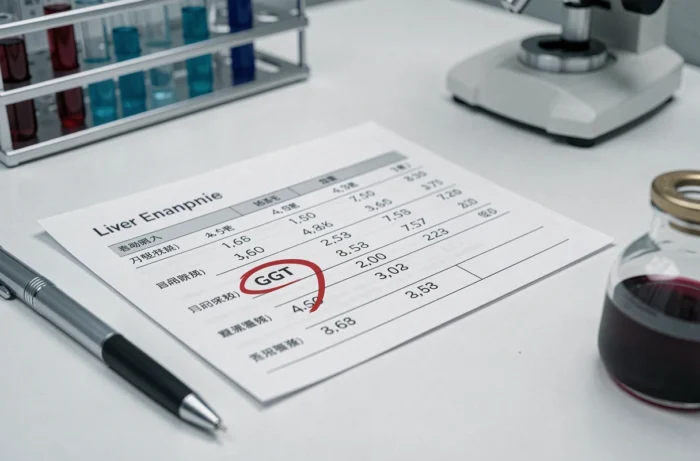
Normal values differ between men and women. In women, the threshold is generally lower, meaning that a value perceived as “slightly elevated” in a man may already be significant in a woman.
Lowering gamma GT without alcohol: concrete levers that work
When the cause is metabolic, gamma-GT responds well to lifestyle changes. We are not talking about drastic diets here, but measurable changes over a few months.
The first lever is reducing visceral fat. Even modest weight loss improves the hepatic enzyme profile in patients with MASLD. Regular physical activity, even moderate (brisk walking, cycling), directly affects insulin resistance and thus the liver’s fat overload.
The second lever concerns diet. Reducing added sugars, limiting saturated fats, and increasing dietary fiber intake helps relieve the liver. Excess fructose, found in sodas and many ultra-processed products, is particularly implicated in liver steatosis.
The third lever, often overlooked, is reevaluating medication treatments with the doctor. Some molecules can be replaced with less hepatotoxic alternatives, provided the benefit-risk ratio allows it.
A biological control at three or six months allows for checking the effectiveness of these measures. If gamma-GT does not decrease despite adjustments, the doctor may refer to a hepatologist for further diagnosis.
The gamma-GT level remains a signal, not a sentence. In non-drinkers, it most often points to a liver accumulating fat or reacting to a treatment. Identifying the right cause allows for early action, before hepatic inflammation progresses to more difficult-to-correct stages.