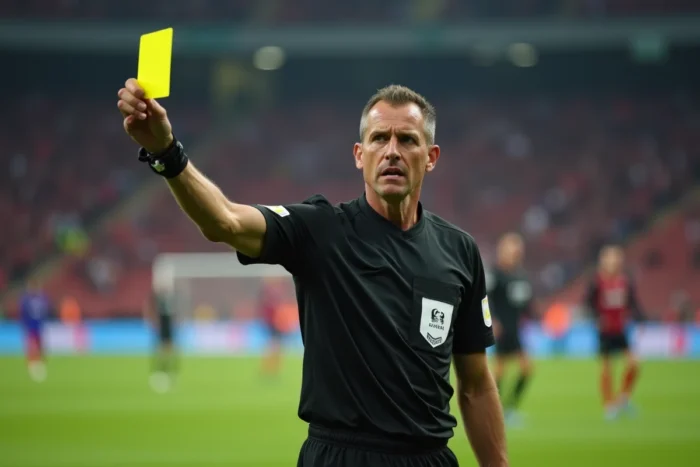
A strong tackle, a gesture of mood, and the referee shows a yellow card. On the field, the sanction is sporting. Behind the scenes of the 2026 World Cup, it also becomes financial. Each yellow card shown by the referee triggers a fine that the federation of the sanctioned player must pay to FIFA. The amount is far from symbolic.
Fine for yellow card in the 2026 World Cup: FIFA scale in Swiss francs
You may have noticed that the media sometimes talks in dollars, sometimes in euros, and sometimes even in Swiss francs? The reason is simple: FIFA sets its fines in Swiss francs, the currency of the country where it is headquartered. The amounts reported in dollars or euros are conversions made by journalists, not official figures.
For the 2026 World Cup, FIFA’s Disciplinary Code establishes a clear scale. A yellow card costs 10,000 Swiss francs to the concerned federation, which is about 10,000 dollars or 8,800 euros at the current exchange rate. This rate applies to each warning, without exception.
An article detailing the cost of a yellow card in the World Cup reminds us that this pricing grid is not new: it is a novelty introduced by FIFA before the 2026 edition, with amounts revised upwards compared to previous competitions.
The red card, on the other hand, costs significantly more. A player sent off incurs a fine of 20,000 Swiss francs for their federation, which is about 20,000 dollars. The bill can quickly add up when a team commits multiple fouls throughout a tournament.

Yellow cards in the World Cup: who actually pays the fine?
A point often misunderstood: it is not the player who pulls out their wallet. The fine is addressed to the national federation that is a member of FIFA. In practical terms, if a player from the French team receives a yellow card, it is the French Football Federation (FFF) that pays the bill.
Why this choice? FIFA believes that discipline on the field is the collective responsibility of the federation, not the individual. It is the federation that selects, trains, and prepares its players. Therefore, it bears the financial consequences of their behavior.
To give you an idea, a match like France – Spain in the group stage would have cost approximately 20,000 dollars in fines to the FFF, by adding up the cards given to French players during that match. Over the course of a tournament, an undisciplined team can accumulate tens of thousands of dollars in penalties.
FIFA collective penalty: the additional sanction beyond five cards
The scale per card is not the only financial mechanism. FIFA has provided for a collective penalty that adds to the individual fines. Here’s how this double layer of sanctions works:
- Each yellow card triggers a fine of 10,000 Swiss francs, and each red card a fine of 20,000 Swiss francs, charged to the federation.
- When a team accumulates at least five sanctions (yellow and red cards combined) during the tournament, an additional collective penalty applies, on top of the total of individual fines.
- This system aims to discourage strategies of repeated tactical fouls, where a team would accept to take cards to disrupt the opposing game.
With a table of 48 teams and extended group stages, the total number of matches has significantly increased compared to previous editions. More matches means mechanically more cards and heavier bills for the less disciplined federations.

Resetting yellow cards: at what stage of the tournament?
You may be wondering if a player who accumulates yellow cards in the group stage is penalized throughout the tournament? The answer lies in a reset mechanism.
In a tournament with 48 teams, the management of yellow cards follows a precise schedule. Accumulated warnings are cleared at a certain stage of the competition, to prevent a player from being suspended in the semi-finals or finals due to a card received in the first match.
Suspension occurs after two yellow cards accumulated in different matches. Once the reset threshold is passed, the count starts over for all players still in the running. This mechanism concerns sporting suspension, not financial fines: the federation pays for each card, whether it has been annulled sportingly or not.
FIFA fine scale for the 2026 World Cup
| Type of sanction | Amount (Swiss francs) | Approximate equivalent (dollars) |
|---|---|---|
| Yellow card | 10,000 CHF | ~10,000 $ |
| Red card | 20,000 CHF | ~20,000 $ |
| Collective penalty (5+ sanctions) | Additional penalty | Variable |
This table summarizes the scale applied by FIFA for the 2026 edition. Federations receive the bill after each competition day.
The shift to 48 teams and the increase in the number of matches have mechanically inflated the total amount of fines collected by FIFA throughout the tournament. For federations with more modest budgets, such as those from certain African countries or Central America, each yellow card represents a significant financial burden. Discipline on the field has literally become a matter of budget management.