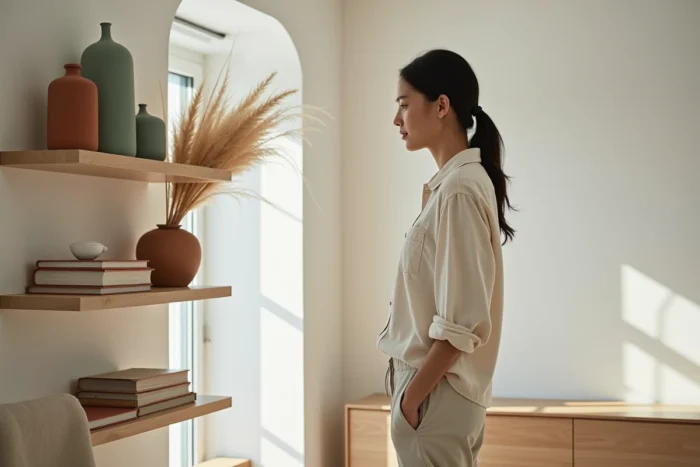
Decorating an interior without drilling a single wall, without engaging in renovations, and without turning every room into an overloaded showroom: this is the real challenge for most renters and inhabitants of small spaces. Easy interior decoration is not just about accumulating trendy objects. It relies on a few specific, measurable levers that change the perception of a room without touching the structure.
Rental decoration: what works without drilling walls
The first reflex when renting is to give up. No nails, no screws, so no frames, no shelves, no personalization. This reasoning overlooks a series of solutions that leave nothing damaged and transform a space in just a few hours.
Repositionable adhesive strips can now support enough weight to hang mirrors, frames, and small shelves. Floor-standing shelves, narrow consoles, and low furniture create vertical storage without wall fixation.
Washi tape, removable wall stickers, and self-adhesive wallpaper allow you to dress a white wall without leaving marks at the time of the inventory. For floors, a well-sized rug redefines the living area or dining area in a studio, without any intervention on the existing flooring.
Those exploring decor on Monsieur Bricoleur will find several techniques suited to rented accommodations, focused on the total reversibility of the arrangements.
- Replace kitchen cabinet handles with brass or ceramic models (reversible, immediate visual impact on the room).
- Install adhesive wooden baseboards to break the monotony of a dark floor without touching the covering.
- Use long curtains from floor to ceiling, fixed on a tension rod, to give the illusion of higher ceilings.
- Opt for a large mirror leaning against the wall rather than hung: it visually enlarges the space and can be moved at will.

Materials and colors: a comparison of decor choices by room type
The choice of colors and materials directly depends on the function of the room, its natural brightness, and its size. A north-facing living room does not react the same way as a southwest-facing bedroom. The table below crosses these parameters to identify the most effective combinations.
| Room | Recommended wall color | Dominant material | Trap to avoid |
|---|---|---|---|
| Living room (small, dimly lit) | Off-white or warm beige | Washed linen, light wood | Dark wall that visually shrinks the space |
| Living room (large, bright) | Terracotta, sage green, muted blue | Natural stone, boucle wool | All-white look that flattens volumes |
| Bedroom | Powdery tones (pink, pearl gray) | Ceramics, rattan, thick cotton | Too bright colors that disrupt rest |
| Kitchen/dining room | Warm white + a colored wall | Solid wood, stoneware | Overloading decorative elements on the countertop |
The return of raw and artisanal materials is confirmed: solid wood, linen, boucle wool, ceramics with imperfect finishes are gaining ground against smooth and standardized surfaces. This trend favors small budgets, as a unique handcrafted object (a stoneware vase, a rattan basket) adds more character than a series of industrial accessories.
The rule of a unifying color thread
A coherent interior relies on three colors maximum per room: one dominant (walls, floor), one secondary (sofa, curtains), and one accent (cushions, decorative objects). Exceeding this threshold creates visual saturation that fatigues the eye, especially in small spaces.
On the other hand, playing with shades of the same hue (a range of greens, variations of beiges) allows for multiplying decorative elements without weighing down the overall look. Pure white, long considered a neutral default choice, tends to fade in favor of warm whites and immersive shades that give depth even to the most modest rooms.

Lighting and furniture arrangement in a small space
Light does more for the perception of a space than the color of the walls. A living room with a single ceiling light appears narrower than a living room illuminated by three distinct sources, even of low intensity.
Multiplying light sources at different heights radically changes the atmosphere of a room. A low table lamp, a corner floor lamp, and a string of lights placed on a shelf are enough to create zones of shadow and light that visually enlarge the space.
Sofa and table arrangement
In a narrow living room, the common reflex is to push the sofa against the wall. This arrangement frees up the center of the room but creates an unwelcoming visual corridor. Moving the sofa a few inches away from the wall, even in a small living room, generates smoother circulation and a sense of depth.
The coffee table benefits from being light and transparent (glass, acrylic) in small spaces, or replaced by two side tables that can be moved as needed. A mobile piece of furniture is better than a bulky one in a small living space.
- Favor furniture on legs (sofa, sideboard) rather than furniture placed on the floor: visible flooring under the furniture lightens the room.
- Place the largest piece of furniture facing the entrance of the room to create an immediate focal point.
- Clear window sills: every centimeter of natural light blocked by an object reduces the feeling of space.
Plants and natural elements: living decoration without overload
Bringing vegetation into an interior does not mean turning your living room into a greenhouse. Two or three well-chosen and well-placed plants have more impact than a dozen small pots scattered across every available surface.
A tall plant (ficus, artificial strelitzia if light is lacking) placed in a blind corner fills a visual void and draws the eye upward. Cascading plants on a high shelf add movement without cluttering the horizontal plane.
The rising decor style combines vegetation, raw wood, and natural textiles in a logic of sobriety. Rattan, woven baskets, and stoneware planters contribute to this coherence of materials without multiplying purchases. A successful interior rarely depends on the quantity of objects: it relies on the accuracy of each choice, its coherence with the available space, and the ability of each element to exist without cluttering.