
Access to sports news no longer goes through a single channel. Between traditional news sites, score aggregators, social media, and artificial intelligence tools, sources of sports information have multiplied to the point of blurring the lines. Knowing where to look depends as much on the sport being followed as on the type of content sought: raw results, tactical analysis, live video, or automated summaries.
AI as a sports source: what the initial data says
None of the main articles referenced on the subject treat AI assistants or automated summaries as standalone sources of sports information. Usage, however, is advancing rapidly.
A study by the Capgemini Research Institute relayed by the Sports AI Chair and ICN Artem indicates that 54% of fans trust AI for accessing sports information. The figure rises to 59% when it comes to sports content generated by artificial intelligence. A notable portion of these fans even say they are willing to pay more for experiences enhanced by AI (real-time statistics, virtual environments).
To find sports information on Sport en Ligne categorized by discipline, this type of editorial aggregation remains complementary to automated feeds, as it retains human sorting on the hierarchy of topics.
Field feedback varies on the actual reliability of these AI tools when it comes to ongoing match results or unconfirmed transfers. The speed of generation does not guarantee verification or contextualization. An erroneous score propagated by a chatbot during a live event can circulate for several minutes before correction, whereas a sports editorial team applies a validation circuit.
Social media and under 25s: a shift in the main channel
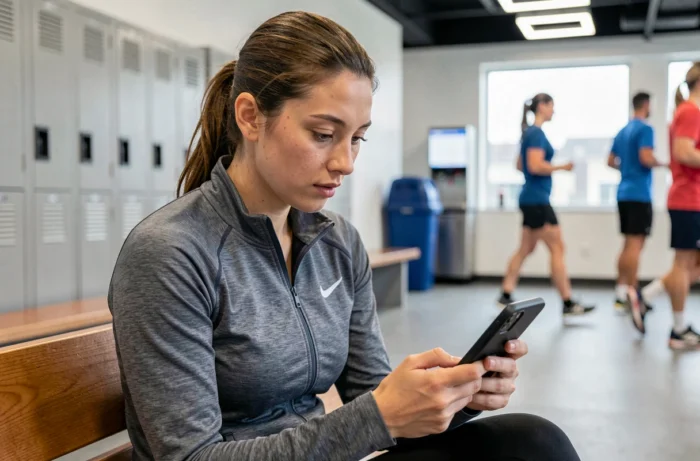
Articles comparing the best sports sites focus on established media. They overlook a documented phenomenon: the main channel for sports information for those under 25 has shifted to TikTok, Instagram, and X.
This is no longer a supplement. For this age group, the first contact with a Ligue 1 result or a significant event from European championships often comes through a story, a vertical clip, or a post. A media site like L’Équipe or franceinfo comes into play later when the reader seeks further development or confirmation.
This shift raises a reliability issue. On social media, virality takes precedence over verification. A high-audience account can publish a score or a transfer rumor without sourcing, and the content reaches tens of thousands of people before any correction. The official accounts of federations or clubs offer a more reliable alternative, but their editorial line remains promotional.
What this changes for multisport tracking
Following the Tour de France, the European swimming championships, or an ATP tournament like Cincinnati via social media requires following multiple accounts. There is no social algorithm that neutrally aggregates results from multiple disciplines. The platforms favor football, PSG, and controversial content.
A score aggregator like FlashScore or a dedicated app remains more effective for raw multisport tracking. However, for analysis, long reporting, or investigations, news sites retain a structural advantage due to their editorial staff.
Sports piracy and real-time blocking: the tightening framework in France
The law on professional sports adopted in France has strengthened penalties against illegal streaming. Automatic blocking of pirate streams can now occur during a match, a major evolution compared to traditional judicial procedures that took weeks.
At the European level, a study commissioned by the European Parliament explores the possibility of blocking pirate sports streams in less than 30 minutes by acting simultaneously on DNS resolvers, VPNs, and CDNs. The available data does not yet allow for measuring the actual effectiveness of these systems on a large scale, but the direction is clear: unauthorized free access to sports broadcasts is gradually closing.
For the consumer, this means that legal sources become the only stable channel for watching a match live. Cost remains a friction point. The fragmentation of TV rights among DAZN, beIN Sports, Canal+, and other broadcasters forces subscriptions to be accumulated to cover all disciplines, from football to swimming to cycling.
Fragmentation of TV rights in Europe
The market is moving quickly. DAZN and Disney+ recently acquired the rights to La Liga, previously broadcast by beIN Sports. This type of shift alters the map of available sources from one season to the next. Here are the criteria to watch before subscribing:
- The actual coverage by discipline: a broadcaster may hold the rights to football but not to athletics or table tennis, two sports that are present at the European championships
- Geographical availability: some subscriptions do not work outside the national territory, limiting tracking while traveling
- Stream latency: for live tracking, delays of a few seconds between platforms can spoil the experience if social media spoils the result before the broadcast

Reliability and speed: the criteria that differentiate sports sources
The speed of broadcasting a score is worthless if the score is wrong. Stats Perform, a data provider for many media outlets, emphasizes that the speed of collection is a decisive competitive advantage for sports results platforms. A few seconds of delay are enough to lose a user to a more responsive source.
Traditional media (L’Équipe, franceinfo sport, RMC Sport) compensate for this slight delay with depth of coverage. An analysis article published two hours after a swimming final at the European championships provides value that neither a raw score nor an AI summary can replace.
- For live scores: FlashScore, SofaScore, or the widgets integrated into the applications of official broadcasters
- For analysis and context: sports newsrooms with accredited journalists (L’Équipe, Eurosport, franceinfo)
- For raw responsiveness: the official accounts of federations and leagues on X or Instagram, with reservations related to the editorial line
The choice of a source depends on what one is looking for: an immediate football result, an analysis of Gressier’s bronze in the 10,000m, or tracking the Parisian transfer market. No single platform covers all these needs with the same level of quality. Cross-referencing two or three sources remains the most reliable method for following news across multiple disciplines without relying on a single editorial or algorithmic filter.