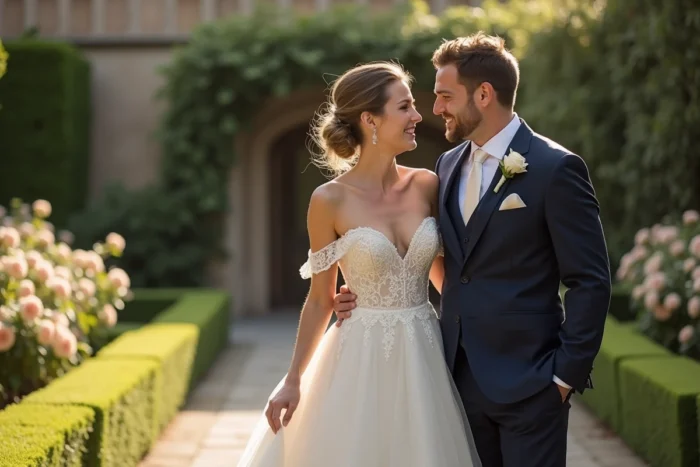
In France, the average wedding costs €19,293 in 2026, but this figure masks a profound transformation in formats. Large tables are declining in favor of ceremonies focused on the guests’ experience. Organizing an unforgettable wedding no longer involves accumulating budget items, but rather making precise trade-offs between the venue, the ceremony, and the overall atmosphere of the day.
Stable wedding budget, but reallocation towards guest experience
The underlying trend for 2025-2026 can be summed up in one phrase: no more large tables, back to basics. The overall budget does not decrease, but its allocation changes. Couples are reducing the number of guests to invest more in staging, photo and video content, quality furniture, or targeted entertainment.
A wedding with seventy guests featuring a carefully crafted setup is gradually replacing the reception for one hundred and twenty people with a standard menu. The experience each guest has becomes the measure of success, not the size of the guest list.
To follow this evolution and compare possible formats, several couples begin their research by looking for information on the Wedding News site before finalizing their organization.
Choice of ceremony venue: what recent data shows
The available data provides clear insight into venue choice, beyond the atmospheres often mentioned without supporting figures.
- 19% of weddings take place outdoors or in gardens, which remains a minority despite the media enthusiasm for outdoor ceremonies.
- Private estates and traditional reception halls still capture the majority of celebrations.
- The format of an outdoor secular ceremony followed by an indoor reception is gaining ground, as it combines the photogenic quality of a natural setting with the logistical comfort of an equipped hall.
The venue influences half of the subsequent decisions (caterer, decoration, seating plan). Choosing the venue before setting the theme or guest list remains the most coherent order, as a venue imposes its constraints regarding capacity, access, and sound.
Color palette and theme: what is predominant and what differentiates
White and neutral tones lead with 35% of color choices, tied with green tones. Earthy warm tones represent about 20% of the selected palettes. These figures paint a very different picture from what Pinterest boards dominated by blush pink or lavender blue suggest.
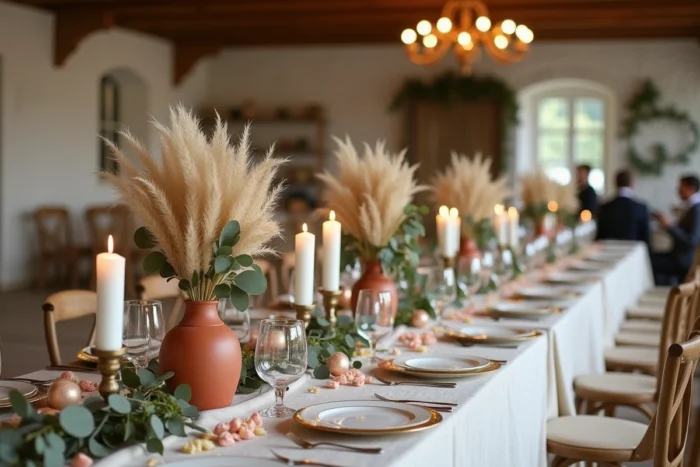
For a wedding that stands out without falling into eccentricity, earthy colors (terracotta, ochre, sand) offer a positioning that is still minority but on the rise. When paired with natural materials (linen, raw wood, ceramics), they create a strong visual coherence in photos without requiring an oversized decoration budget.
Cinema or literature themes, sometimes presented as rising trends, remain marginal in the data. They work well when the couple truly masters them, but a theme imposed without personal conviction quickly becomes apparent and tires the guests.
Coherence between palette and venue
A common pitfall is choosing a palette on screen without checking its rendering in the actual venue. Saturated green tones that appear elegant on a mood board may visually disappear in a venue surrounded by vegetation. Conversely, earthy warm tones stand out well in a mineral space or a room with light walls.
Ceremony and rituals: the re-legitimization of marriage as a moment of speech
Beyond logistics, a less visible underlying trend is transforming the very content of the ceremony. Marriage is regaining its function as a social ritual where the couple publicly shares their story. Secular ceremonies increasingly incorporate structured speeches, readings chosen by loved ones, and personalized vow exchanges.
This narrative dimension influences concrete choices:
- The duration of the ceremony is lengthening (often between thirty and forty-five minutes for a complete secular ceremony), which requires appropriate sound equipment and comfortable seating for guests.
- The choice of officiant becomes a significant consideration, not a last-minute detail.
- The speech and vows require real preparation, sometimes accompanied by a public speaking coach or a professional officiant.
This refocusing on the ritual partly explains the reduction in the number of guests: an intimate ceremony where each person present matters to the couple has more emotional impact than a celebration in front of two hundred people, half of whom are distant acquaintances.
Wedding organization: the trade-offs that really matter
Rather than a chronological list of steps (date, budget, vendors), three trade-offs truly structure the preparation of an unforgettable wedding.
The first concerns the guest/budget ratio per person. Reducing the list by twenty guests often allows for doubling the budget allocated to each guest’s experience (menu, welcome, gifts). It’s a simple arithmetic calculation, but few couples explicitly consider it before sending out invitations.
The second concerns the allocation of time on the big day. A tightly packed schedule between the ceremony, cocktail, meal, and evening creates stress and prevents spontaneous moments. Allowing thirty-minute breaks without a program between each key moment radically changes the atmosphere.
The third concerns delegation. Some couples regret having delegated too much to a wedding planner at the expense of their personal choices, while others wish they had delegated earlier. Selective delegation, where the couple retains control over the ceremony and atmosphere but entrusts the logistical coordination of the big day, often offers the best balance.
The typical wedding in France remains rooted in codes that evolve slowly, but couples who succeed in creating a memorable day are generally those who have made few choices, but have made them with precision. An appropriate venue, a coherent palette, a prepared ceremony, and a relaxed schedule are enough to produce a wedding that guests will talk about for a long time.