
Purslane (Portulaca oleracea) is an annual plant from the Portulacaceae family. Its fleshy leaves, typical of succulents, allow it to store water and thrive in dry, compacted, and poor soils. In a lawn, it establishes itself as soon as the grass reveals sparse or too short areas, as its seeds germinate under the combined effect of heat and direct light on the soil.
Reproductive cycle of purslane and impact on the lawn
Understanding the biology of purslane allows for timely action. This annual plant germinates late in spring, when the soil warms up, and then produces seeds in large quantities throughout the summer. A single plant can release thousands of seeds that remain viable in the soil for several years.
The main trap: pulling out a flowering purslane plant and leaving it on the ground. Even uprooted, a fragment of stem can take root or release its seeds. The fleshy stems contain enough water reserves to survive several days out of the ground and mature their seed capsules. Therefore, any pulled plant must be removed from the lawn and placed in a bag, not on the compost.
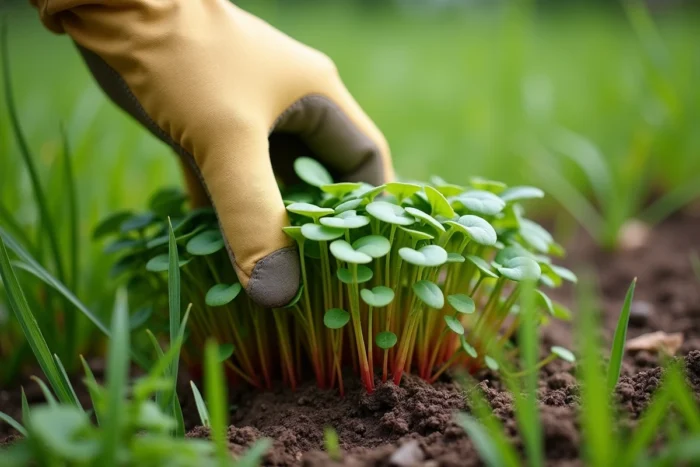
Uprooting should occur before flowering, ideally when the seedlings are only a few centimeters tall. At this stage, the roots are superficial and come out easily. Waiting for purslane to form a sprawling mat makes the task more difficult, as the stems lying on the ground develop adventitious roots at each node. Several methods exist to eliminate purslane in a lawn sustainably without resorting to synthetic herbicides.
Mowing height of the grass: the underestimated preventive lever
Most guides on purslane focus on uprooting and mulching. They overlook a fundamental parameter: the height at which the grass is mowed largely determines whether purslane can establish itself or not.
Raising the mowing height to about 7 to 8 cm in summer allows the grass blades to shade the soil. Purslane seeds need light and heat to germinate. A dense and tall lawn creates a plant cover that blocks these two conditions.
A lawn mowed too short (3 to 4 cm), on the other hand, exposes the soil and promotes superficial warming of the ground. This is exactly what purslane seeks. Mowing high has a second benefit: longer grass blades develop a deeper root system, making the lawn more resistant to summer drought and reducing bare areas where weeds can take hold.
Adjusting mowing frequency
Mowing high does not mean mowing less often. The one-third rule still applies: never cut more than one-third of the blade height in a single mowing. In summer, mowing every ten to fourteen days is sufficient if the lawn is maintained at the right height. A lawn stressed by too short mowings regrows more slowly and leaves gaps that purslane can colonize in a few weeks.
Densifying the lawn to compete with purslane
Purslane is an opportunistic plant. It does not establish itself in a dense lawn because it cannot compete for light. Therefore, strengthening the density of the grass is a more effective preventive strategy than repetitive uprooting.
Two concrete actions can help densify a lawn:
- Overseeding in late summer or early autumn, when the soil is still warm but nights are getting cooler. Choosing a mix suitable for the soil type (perennial ryegrass for heavy soils, tall fescue for dry soils) helps fill in sparse areas before the next season.
- Moderate organic fertilization in spring and autumn, with a slow-release nitrogen-rich fertilizer. A well-nourished lawn produces denser foliage and directly competes with weeds. Excessive nitrogen, on the other hand, promotes rapid growth at the expense of rooting.
- Soil aeration by coring once a year in autumn on compacted grounds. Purslane thrives in compacted soils. Loosening the soil encourages deep rooting of the grass and reduces conditions favorable to purslane.
Why mulching does not work in a lawn
In a vegetable garden or flower bed, mulching effectively blocks the germination of purslane. In a lawn, this method is impractical: you cannot mulch grass. This is precisely why the density of the herbaceous cover replaces mulching. A dense lawn acts as a living mulch by covering the soil and preventing light from reaching dormant seeds.
Targeted weeding and manual techniques suitable for lawns
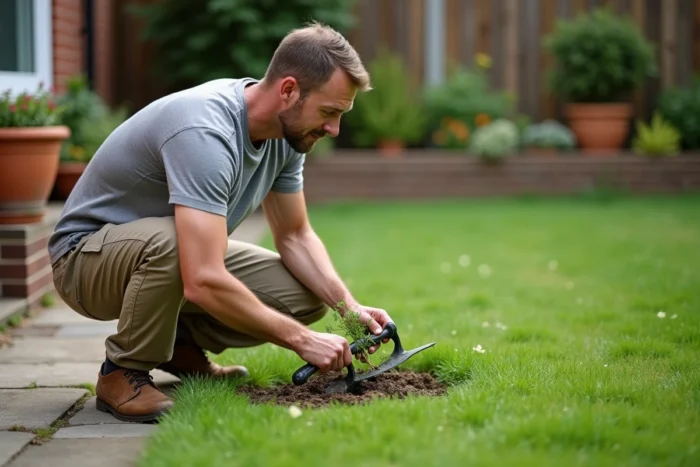
When purslane is already established in the lawn, manual uprooting remains the most reliable method without chemicals. The weeding knife, with its narrow and long blade, allows for the extraction of plants with their taproot without disturbing the surrounding grass too much.
Some principles to follow:
- Intervene after rain or watering, when the soil is loose. The roots come out whole instead of breaking.
- Work section by section rather than traversing the entire lawn. Purslane forms localized colonies, often in the sunniest and shortest areas.
- Systematically collect all stem fragments. A forgotten piece of purslane on the ground can take root in a few days if conditions are favorable.
- Avoid deep hoeing: this would bring buried seeds to the surface that would germinate the following season.
Thermal weeding (flame or steam) works on paths and hard surfaces, but its use on a lawn also scorches the grass. This technique should be reserved for borders and paving joints.
Managing purslane over multiple seasons
The stock of purslane seeds in the soil does not deplete in one year. Chemical-free control requires consistency over two to three seasons. Each year that purslane does not go to seed reduces the seed reservoir in the soil.
The most effective strategy combines the three levers discussed: high mowing in summer, overseeding and fertilization to densify the grass, early uprooting before flowering. None of these actions taken in isolation is sufficient. It is their combination that gradually deprives purslane of its establishment conditions: bare soil, direct light, and lack of root competition.
Purslane is also an edible plant rich in omega-3 fatty acids, widely used in the Cretan diet. Instead of discarding the uprooted plants, the younger leaves can be added to salads. This is a form of management that transforms a weeding chore into a useful harvest.